
Wholesale SINOTRUK HOWO Parts for Buyers in Mongolia
Mongolian mining fleets, road-transport operators, construction companies, heavy-truck workshops, dealers, wholesalers and importers can source SINOTRUK HOWO parts wholesale from China. An accurate order begins with an itemized parts list, quantities, vehicle and assembly identification, required quality options, packing instructions and the final delivery point.
HOWO PARTS handles B2B supply and export preparation from China. This article does not claim a warehouse, branch, local inventory, service centre or technical team in Mongolia. Availability, compatibility, packing, freight scope and lead time are evaluated against the actual order rather than assumed from a general product category.
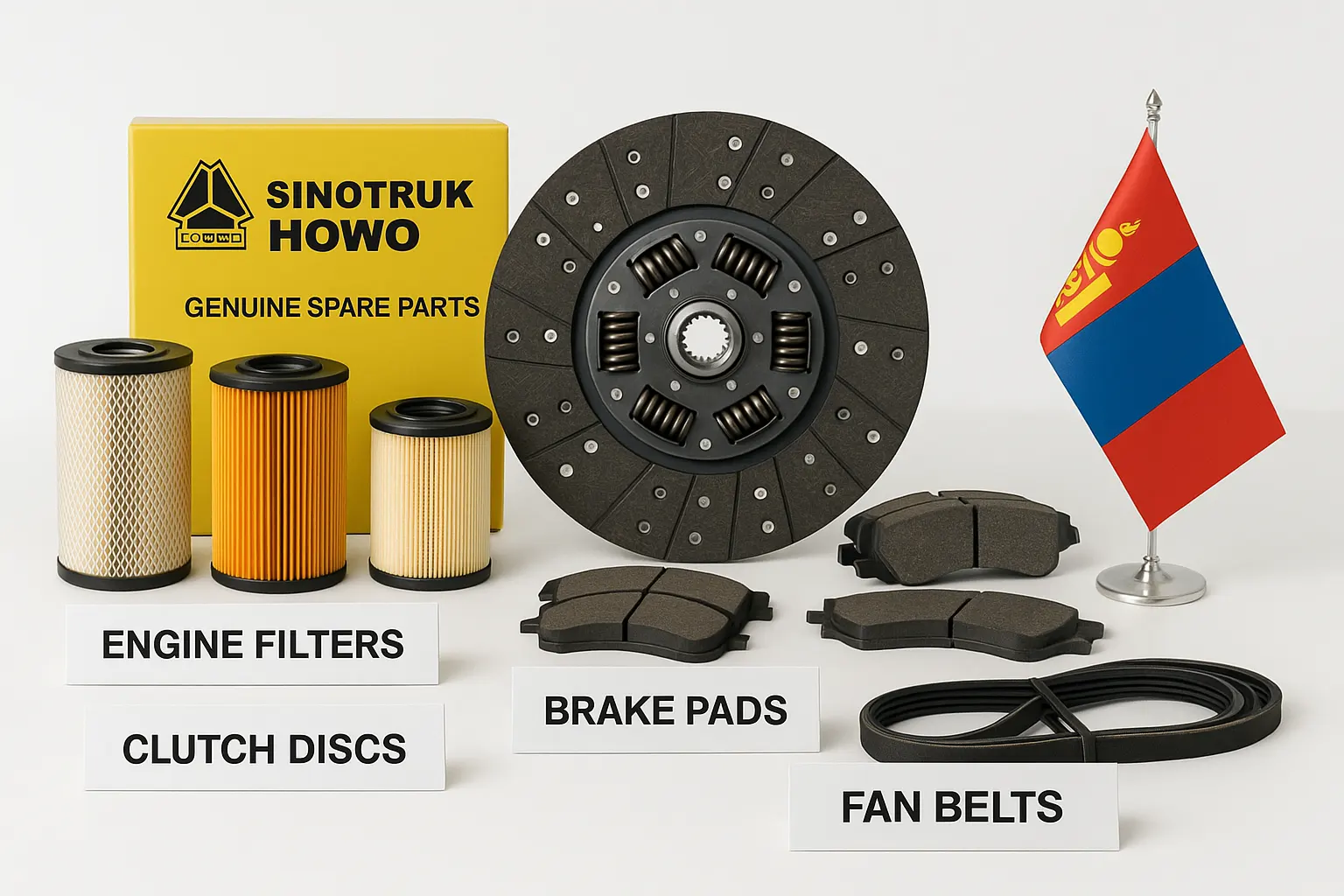
Quick Procurement Answer
For a Mongolia-bound wholesale order, provide one spreadsheet containing the part number, description, quantity and required quality tier for every line. Add the VIN or chassis number, assembly nameplates, old-part photos, dimensions and connector details where relevant.
Mixed parts orders may be discussed, but every SKU must be verified and labelled separately. A “winter” description is not enough to prove low-temperature suitability. Freight cannot be compared until the handover point, China–Mongolia route, border responsibility, final city or mine location and unloading capability are defined.
The practical sequence is to consolidate the list, resolve high-risk lines, verify the installed assemblies, choose each quality option, approve alternatives, define packing and confirm the named delivery point before requesting the final quotation.
Why Mongolia’s Operating Environment Changes Parts Planning
Mongolia’s operating environment makes specification control and preventive stock planning more important. The country combines large mining and freight applications with severe winter conditions, dry dust, long distances and inland border-dependent replenishment. These factors affect what buyers inspect and stock, but they do not create one universal “Mongolia specification” for every HOWO truck.
The Mineral Resources and Petroleum Authority of Mongolia reported 2025 coal production of about 105.5 million tonnes and coal exports of about 78.4 million tonnes. The official 2025 mining statistics confirm the importance of mining and mineral transport to the operating environment. They do not show HOWO’s fleet size or market share, so they should not be used to claim that SINOTRUK HOWO trucks dominate Mongolian mines.
The WTO Mongolia trade profile records China as the source of 40% of Mongolia’s goods imports by value in 2024. It also records off-highway dumpers under HS 870410 as 4% of imports by value. These figures support the China-sourcing and heavy-equipment angle, but not any supplier’s or truck brand’s sales performance.
The World Bank climate overview for Mongolia includes extremely cold subarctic zones. Buyers should verify starting, charging, fuel, cooling, heating, air and rubber-component specifications rather than accept an unsupported “winter version” label.
| Operating condition | Systems most affected | Inspection focus | Purchase evidence required | Stock-planning response |
|---|---|---|---|---|
| Severe cold | Starting, charging, fuel, cooling, heating, air and rubber systems | Slow cranking, weak charging, fuel restriction, coolant leaks, brittle hoses and air-system moisture | Voltage, starter power, alternator output, filter reference, thermostat specification, material or temperature range | Hold verified critical starting and service items before the cold season |
| Dry dust and wind | Air intake, filtration, cooling, electrical connectors and cab sealing | Clogged filters, radiator contamination, worn seals and dust entry | Filter number and dimensions, intake configuration, connector and seal design | Base filter stock on actual consumption and inspection records |
| Mine or quarry haul roads | Brakes, suspension, steering, wheel ends and driveline | Heat, wear, looseness, bearing condition, seal leakage and joint play | Axle model, brake size, position, dimensions, threads and assembly photos | Separate vehicle-off-road items from ordinary road-service stock |
| Long-distance road operation | Clutch, brakes, cooling, charging and tyres | Repeated heat cycles, charging reliability and roadside repair exposure | Truck configuration, duty cycle, route and maintenance history | Stock critical parts according to downtime cost and replenishment time |
| Remote workshop or project site | All vehicle-off-road systems | Availability of tools, lifting equipment and replacement assemblies | Final location, unloading capability and workshop resources | Combine preventive items in planned replenishment orders |
| Border-dependent replenishment | Fast-moving and critical repair parts | Current route, handling stages and final inland transfer | Named place, forwarder instructions, border scope and consignee data | Use realistic replenishment intervals rather than a fixed transit promise |
Which Mongolian Buyers Need HOWO Parts?
Relevant B2B buyers maintain fleets, repair several truck generations, distribute recurring service parts or coordinate cross-border purchasing. Each should build the order around its equipment list and service records.
| Buyer | Main application | Priority purchasing areas | Main procurement risk |
|---|---|---|---|
| Mining fleet maintenance team | Dump, haulage and mine-support trucks | Filtration, cooling, brakes, wheel ends, suspension, drivetrain and critical repair parts | Mixing road-truck parts with dedicated mining-vehicle components |
| Coal or mineral transport fleet | Long-distance and border-route transport | Clutch, brakes, air system, cooling, electrical and scheduled service parts | Emergency ordering without allowing for border and inland replenishment |
| Construction company | Project dump trucks and support vehicles | Brakes, clutch, suspension, cooling, cabin and maintenance items | Ordering from a commercial model name without assembly confirmation |
| Heavy-truck repair workshop | Mixed repair jobs across different production years | Engine, gearbox, axle, brake, electrical and cab parts | Treating visually similar parts as interchangeable |
| Parts dealer or wholesaler | Fast-moving stock and customer-specific orders | Filters, belts, hoses, brake and air parts, sensors, lamps and selected repair kits | Overbuying expensive assemblies with slow turnover |
| Importer or distributor | Consolidated procurement and inland distribution | Item control, packing, documents, HS classification and freight scope | Comparing quotations with different delivery points and responsibilities |
Mining should be a major application section, not an excuse to treat every truck as a mine vehicle. A road-going 6×4 tractor, an 8×4 construction dump truck and a dedicated off-highway mining dumper can use different axles, brakes, suspension, wheels and driveline components.
HOWO Parts Categories for Mining, Transport and Workshop Orders
You can use the HOWO truck parts overview to organize a mixed inquiry and the HOWO parts catalog to identify product groups. The final quotation must still be based on the installed truck and assembly information.
Engine, Filtration and Cooling Parts
Engine inquiries may include filters, fuel-water separators, starters, alternators, water pumps, thermostats, radiators, fans, belts, tensioners, hoses, seals, injectors and internal components.
For filter products, provide the printed reference and dimensions. For engine repair parts, provide the engine model and serial number, not only a statement such as “HOWO 371.” Review the HOWO engine parts range when preparing the list.
Brake, Air and Wheel-End Parts
Typical brake and wheel-end inquiries include drums, shoes, chambers, slack adjusters, valves, air dryers, cartridges, compressors, bearings, hub seals and repair kits.
The minimum data can include axle model, front or rear position, brake size, valve part number, port arrangement and old-part photos. Use the HOWO brake parts category as a reference, but do not approve a safety-critical part by appearance alone.
Clutch, Gearbox and Driveline Parts
Clutch inquiries may cover the disc, pressure plate, release bearing, booster, master cylinder and related controls. Gearbox and driveline orders may include gears, synchronizers, shafts, bearings, seals, shift components, range cylinders, propeller shafts, universal joints, differentials and axle components.
Internal transmission parts require the gearbox nameplate, exact model, markings, tooth or spline counts and clear photos. The HOWO gearbox parts page can help buyers structure the inquiry.
Suspension, Steering, Electrical and Cabin Parts
Common categories include leaf springs, U-bolts, torque rods, bushings, steering parts, sensors, lamps, connectors, wipers, mirrors, cab mounts and heater components.
Cold-start and charging inquiries should include voltage, power or output, plug design, pin count, cable length and installation position. Review the HOWO electrical parts and HOWO cabin spare parts pages for relevant categories.
| Part category | Typical products | Application focus | Minimum identification data |
|---|---|---|---|
| Engine and filtration | Filters, fuel-water separator, pump, injector and overhaul parts | Scheduled maintenance, fuel cleanliness and engine repair | Engine model and serial, part number, markings and dimensions |
| Cooling and heating | Water pump, thermostat, radiator, fan, hose and heater components | Cold operation, heat control and cab function | Engine model, connection layout, dimensions and specification |
| Starting and charging | Starter, alternator, relay, cable and switch | Cold starting and electrical reliability | Voltage, power/output, plug, label, mounting and old unit |
| Brake and air | Drum, shoe, chamber, valve, air dryer and cartridge | Mine, construction and road safety | Axle, brake size, valve number, ports and position |
| Wheel end and suspension | Bearing, hub seal, spring, U-bolt, bushing and torque rod | Rough-road load and wheel-end maintenance | Axle, dimensions, thread, position and old part |
| Clutch and gearbox | Disc, pressure plate, bearing, gear, shaft and synchronizer | Stop-start work and drivetrain repair | Gearbox plate, diameter, teeth, splines, markings and photos |
| Electrical and cabin | Sensor, lamp, connector, mirror, wiper and cab mount | Visibility, control, monitoring and cab repair | Cab model, LH/RH side, voltage, plug, pins and mounting |
Why “HOWO 371” Is Not Enough for Parts Identification
“HOWO 371” normally points to a broad truck or horsepower description. It does not identify every engine production version, gearbox, axle, cab, brake system, sensor or later modification. Ordering only from this description can produce a part that looks correct but differs in mounting, teeth, splines, connector, voltage or calibration.
Use the strongest available evidence in the following order:
- exact part number and readable markings;
- VIN or chassis number;
- engine model and serial-number plate;
- gearbox model and nameplate;
- axle model and installed position;
- truck model, year and axle configuration;
- cab model and left/right installation side;
- clear old-part photos from several angles;
- dimensions, teeth, splines, threads, ports, pins and voltage.
| Verification evidence | What it can confirm | Important limitation |
|---|---|---|
| Exact part number and markings | A component reference and possible production version | A number may be incomplete, superseded or supplier-specific |
| VIN or chassis number | Original vehicle configuration | It may not show later modifications or substituted assemblies |
| Engine nameplate | Installed engine family, model and serial | The plate must be readable and complete |
| Gearbox or axle nameplate | Installed major assembly | Internal parts may still require tooth, spline and dimension checks |
| Truck model, year and axle layout | General vehicle variant | A commercial model name is not a complete parts identifier |
| Old-part photos | Housing, connection, port and mounting layout | Similar appearance does not guarantee compatibility |
| Measurements and counts | Technical comparison between close variants | Inaccurate measurement or counting can produce a false match |
| Installation position | Front/rear and LH/RH application | Position alone does not identify the specification |
Photo Requirements
Photograph the complete old part and close-ups of labels, stamped or cast numbers, connectors, ports and mounting holes. Show dimensions with a ruler or caliper and include the relevant assembly plate. For electrical parts, show the plug and pins; for gears or shafts, provide tooth or spline counts; for cab parts, state the installation side and cab version.
How to Verify Cold-Climate Parts Without Buying a “Winter” Label
A low-temperature specification is a documented operating range, material rating or component performance value. It is not a general claim printed in a quotation. There is no universal “Mongolia winter kit” for all SINOTRUK HOWO trucks.
For cold-start items, compare the electrical system with the starter voltage and power, alternator output, battery arrangement and cold-cranking data if batteries are included. Mounting, rotation, gearing, connections and charging compatibility still matter.
Fuel checks should cover exact filter and water-separator references, connections and any fitted heating function. Cooling checks should cover the thermostat, water pump, hoses, radiator and heater. Fluids must follow the relevant assembly manufacturer’s approved specification.
For rubber components, request the stated material or operating range where low-temperature performance is critical. For electrical parts, verify sealing, cable, pin layout and voltage. Do not accept generic “winter” or “dust-proof” claims without item-specific evidence.
| Cold-climate item | Required specification or evidence | Unsupported shortcut to avoid |
|---|---|---|
| Starter motor | Voltage, rated power, mounting, rotation, drive and control connection | “High-power winter starter” without a data sheet |
| Alternator | Voltage, rated output, pulley, mounting and connector | Selecting only by amperage |
| Battery, if quoted | Voltage, capacity, cold-cranking performance, dimensions and terminal layout | Assuming the largest battery fits or matches the charging system |
| Fuel filter or water separator | Exact reference, dimensions, ports, sensor/heater function and application | “Winter filter” without model and performance evidence |
| Thermostat and cooling parts | Opening specification, engine application, dimensions and connection layout | Choosing a lower-temperature thermostat without engine approval |
| Hose, seal or rubber part | Material or documented operating range, size and installed position | “Anti-freeze rubber” as a generic grade |
| Sensor or connector | Voltage, plug, pins, cable length, sealing and mounting | “Cold-resistant electrical part” without connector and rating data |
| Lubricant or coolant | Approved fluid specification for the installed assembly | Selecting only by a general winter viscosity description |
Base the decision on the installed assembly, documented specification and the fleet’s operating records.
Original, OEM-Quality and Aftermarket HOWO Parts
Quality terms should be defined line by line before price comparison. “Original,” “OEM-quality” and “aftermarket” describe different commercial propositions; they are not interchangeable proof of origin or performance.
Original parts should be supported by item-specific source, manufacturer, packaging and traceability evidence. OEM-quality is a supplier’s quality proposition linked to a named manufacturer and stated specification, but it does not automatically mean the product is the original part. Aftermarket products are made outside the original supply channel and can range from reliable replacement grades to low-cost products with limited traceability.
| Quality option | Commercial meaning | Evidence to request | Suitable purchasing approach | Main risk |
|---|---|---|---|---|
| Original | Product represented as supplied through an original production or brand channel, subject to item-level proof | Part number, manufacturer/source, packaging, traceability and warranty terms | Use where source assurance and exact specification are priorities | Accepting an unsupported “genuine” claim |
| OEM-quality | Commercial replacement linked to a stated maker and specification; not automatically original | Maker, material/specification, test evidence where relevant and warranty | Compare named manufacturers and documented performance | Treating “OEM-quality” as proof of origin |
| Aftermarket | Replacement outside the original supply channel, with quality varying by maker and grade | Maker, material, sample/test information, packaging and warranty | Select the grade according to duty, criticality and resale market | Choosing by unit price or appearance alone |
Safety-critical, precision and internal assembly parts justify stronger traceability. Do not mix grades under one description; record the approved maker or tier in the order, quotation, packing list and receiving inspection.
How Mixed Orders and Spare-Parts Stock Planning Work
A mixed-SKU order combines multiple part numbers and product categories in one commercial shipment. It can help a Mongolian dealer, workshop or fleet combine filters, brake parts, electrical items, engine components, gearbox parts and cabin products rather than arrange separate international shipments.
Mixed shipments can contain visually similar variants, left/right components, different quality tiers and packages with very different weights.
Use one approved spreadsheet with a line number, part number, quantity and quality tier for every SKU. Verify high-risk parts, approve alternatives in writing, label inner packs, separate LH/RH and front/rear products, list repair-kit contents and match every carton or case to the packing list.
For stock planning, separate vehicle-off-road critical items from scheduled service parts and low-frequency assemblies. The correct reorder point depends on usage, failure history, replenishment time, minimum order quantity and downtime cost.
| Stock tier | Purpose | Example parts | Reorder basis | Main control |
|---|---|---|---|---|
| A: downtime-critical | Restore a disabled vehicle or prevent a high-cost stoppage | Selected starter, critical sensor, brake chamber, valve, water pump and verified wheel-end items | Fleet size, failure history, downtime cost and replenishment interval | Confirm exact vehicle and assembly coverage |
| B: scheduled maintenance | Support recurring preventive service | Oil, fuel and air filters, air-dryer cartridges, belts, hoses and selected brake wear parts | Monthly consumption, service interval and safety stock | Use actual issue records, not a generic list |
| C: low-frequency assembly | Support planned rebuilds or customer-specific orders | Gearbox internals, engine overhaul parts, differential components and cabin panels | Order after technical confirmation or against a customer commitment | Avoid tying cash to uncertain variants |
For dealers, sales history is more useful than a universal “fast-moving parts” list. For fleets, combine workshop issue records with vehicle count, duty cycle and seasonal replenishment constraints.
Export Packing for Mongolia-Bound Mixed Shipments
Packing must follow weight, fragility, precision, moisture sensitivity, surface finish and the number of handling stages. A road, rail or multimodal shipment may be transferred between warehouses, terminals and vehicles before it reaches Ulaanbaatar or a remote mine site.
Heavy parts must not load lamps, sensors or precision components. Small kits require separate labelled bags, and every package should remain identifiable after outer wrapping is removed.
| Part type | Main shipping risk | Recommended packing control |
|---|---|---|
| Brake drums, flywheels and heavy housings | Impact, movement and concentrated weight | Reinforced pallet or wooden case, internal blocking and load separation |
| Lamps, mirrors and cab plastic | Breakage, scratching and deformation | Individual cushioning, rigid support and separation from heavy cargo |
| Sensors and electrical parts | Moisture, connector damage, static and SKU mixing | Sealed individual packing, connector protection and clear labels |
| Injectors and precision fuel parts | Impact, contamination and corrosion | Clean sealed protection, cushioning and position control |
| Filters | Moisture, dust and crushing | Dry inner packing and reinforced cartons |
| Seals, bearings and repair kits | Missing pieces, corrosion and SKU mixing | Individual bags, kit-content labels and item-count control |
| Springs, shafts and long parts | Movement, bending and package damage | Bundling or rigid support with protected ends and lifting points |
Available arrangements include cartons, pallets, wooden cases, anti-rust protection, moisture barriers and labels. The importer should confirm any current wood-treatment requirements and whether the final site can unload pallets or heavy cases.
Shipping HOWO Parts from China to Mongolia
Mongolia is landlocked, so the plan should describe road, rail, air or multimodal movement to a precise named place. An international multimodal route may include a sea leg, but sea freight does not terminate in Mongolia.
The Erenhot–Zamyn-Uud gateway is relevant to China–Mongolia road and rail planning. The ADB report on Mongolia’s transport and logistics sector explains that rail freight requires transshipment because Mongolia uses 1,520 mm broad gauge while China uses standard gauge. This additional handling is one reason rail should not automatically be described as faster than road.
A quotation must state whether the seller’s scope ends at a China-side forwarder, Erenhot, Zamyn-Uud, Ulaanbaatar, another city or the final mine. A price to Ulaanbaatar is not delivery to a remote site.
| Delivery basis | Possible handover or destination | Buyer information required | Main cost or control risk |
|---|---|---|---|
| China-side handover | Supplier or nominated forwarder warehouse in China | Warehouse address, contact, receiving hours and booking instructions | Comparing a China-only quote with a Mongolia-delivered quote |
| Road movement | Agreed border gateway, Ulaanbaatar or another inland point | Route, border scope, consignee, final city/site and unloading capability | Border, transfer and final-mile responsibilities are unclear |
| Rail movement | Agreed terminal or inland destination | Station/terminal, transshipment scope, package limits and consignee data | Assuming rail has fewer handling stages or a guaranteed schedule |
| Air freight | Airport or agreed forwarder handover for suitable cargo | Airport, cargo dimensions, weight, restrictions and customs plan | Chargeable weight and destination handling exceed the product value |
| Remote-site delivery | Final mine, workshop or project location | Aimag, exact site, access conditions, contact and unloading equipment | The quoted destination stops before the true receiving point |
Why “CIF Ulaanbaatar” Is Not the Correct Trade Term
The ICC Incoterms 2020 guidance places CIF among rules intended for sea and inland-waterway transport. Ulaanbaatar is an inland destination, so “CIF Ulaanbaatar” is not the correct term for a road, rail, air or multimodal delivery.
FCA, CPT, CIP or DAP may be considered when responsibilities fit. The quotation must state the exact named place and who handles export, carriage, insurance where applicable, border transfer, import customs, duties, taxes and final delivery.
Compare freight offers using the same dimensions, weight, route, border scope, destination charges, delivery point and unloading responsibility.
Mongolia Customs, HS Codes and APTA Checks
HOWO parts do not share one universal HS code. A filter, bearing, starter, lamp, brake part, engine component and complete gearbox may fall under different tariff lines. The importer or customs broker should verify each classification through the Mongolian Customs HS service.
An economy-wide average tariff does not determine the duty on a specific truck part. Before shipment, the Mongolian importer or broker should confirm:
- the exact HS classification;
- current customs duty and VAT;
- permits, restrictions or technical requirements;
- customs value and acceptable supporting documents;
- product description required on the invoice;
- certificate-of-origin requirements;
- eligibility for any available preference;
- consignee and declaration instructions.
Documents may include the commercial invoice, packing list, transport document, declaration information and a certificate of origin where applicable. Requirements depend on the product and importing arrangement.
Mongolia participates in the Asia-Pacific Trade Agreement. UNESCAP reported that APTA trade preferences for Mongolia became effective in 2021. This does not mean that every China-origin HOWO part automatically receives a lower duty.
APTA preference is product-specific and depends on the tariff concession, origin rule, production evidence, certificate and customs acceptance. A certificate of origin alone does not guarantee preferential treatment. The Mongolian importer or broker should confirm eligibility before the seller finalizes documents or represents any duty saving.
Information Required for a Wholesale Quotation
A request must identify the item, quantity, quality expectation and delivery scope. Names such as “HOWO engine parts” or “winter brake parts” are not enough.
Include these fields in one spreadsheet:
- line number;
- part number and description;
- quantity;
- required manufacturer or quality tier;
- truck model, production year and axle configuration;
- VIN or chassis number;
- engine model and serial number;
- gearbox and axle model;
- cab model and installation side;
- old-part photos and readable markings;
- dimensions, teeth, splines, threads, ports, plugs and pins where relevant;
- final city, aimag, border point or mine/project location;
- requested delivery scope and named place;
- packing and package-labelling requirements;
- importer, broker and document instructions.
Recommended Quotation Process
Check the master list, mark incomplete lines and verify high-risk items using vehicle, assembly and old-part evidence. Define each quality tier, obtain written approval for alternatives, separate incompatible packing groups and confirm the named destination, border scope, consignee and broker before issuing the final quotation.
Use this copy-ready inquiry format:
- Part number / description:
- Quantity:
- Truck model and year:
- VIN / chassis number:
- Engine / gearbox / axle model:
- Old-part markings and photos:
- Dimensions / teeth / splines / plug / pins:
- Required quality option:
- Final city, aimag or project location:
- Preferred handover or delivery point:
- Packing and document requirements:
Frequently Asked Questions About SINOTRUK HOWO Parts in Mongolia
Can You Supply SINOTRUK HOWO Parts Wholesale to Mongolia?
Yes. HOWO PARTS accepts B2B wholesale inquiries from Mongolian mining and transport fleets, construction companies, workshops, dealers, wholesalers, importers and resellers. Supply and export preparation are arranged from China after the item list, quantity, compatibility data, quality option, packing and destination are reviewed.
Do You Have a Warehouse or Local Stock in Mongolia?
This article describes wholesale supply from China. It does not claim a Mongolian warehouse, branch, local inventory, service centre or technical team. Availability and lead time are checked against the approved SKU list.
Can Mining, Engine, Brake, Cabin and Gearbox Parts Be Combined?
Mixed-SKU orders may be discussed. Each part number, quantity, quality tier and packing requirement must be confirmed separately. Heavy metal parts, fragile cabin products, sensors, filters and precision components may require different protection within the same shipment.
Which HOWO Parts Are Relevant to Mining and Coal-Haulage Fleets?
Relevant groups can include filtration, cooling, starting and charging, brakes, air systems, wheel ends, suspension, steering, clutch, drivetrain and scheduled maintenance parts. The final list must reflect the actual truck family, axle configuration, duty cycle and failure history.
Is “HOWO 371” Enough to Identify a Spare Part?
No. It is a broad commercial description and does not identify every engine, gearbox, axle, cab, brake or electrical variant. Provide the VIN or chassis number, relevant assembly nameplate, exact part number and old-part evidence.
Do Mongolia-Bound Parts Require a Special Winter Specification?
Some components may require verified low-temperature performance, but there is no universal winter specification for every HOWO truck. Request documented voltage, power, material, operating range or fluid specification appropriate to the component and installed assembly.
Can a VIN Identify Every Replacement Part?
No. A VIN can support the original vehicle configuration, but it may not show later modifications or substituted assemblies. Internal engine, gearbox and axle parts often require nameplates, markings, dimensions, tooth or spline counts and old-part photos.
What Is the Difference Between Original, OEM-Quality and Aftermarket Parts?
Original parts require item-specific source and traceability evidence. OEM-quality is a commercial quality proposition linked to a stated maker and specification, but it is not automatically original. Aftermarket quality varies by manufacturer and grade. Compare evidence, specification, warranty and duty requirement rather than the label alone.
Can Parts Be Delivered Through Erenhot and Zamyn-Uud?
This is a relevant China–Mongolia corridor, and road or rail routing may be discussed with the appointed forwarder. The final feasibility, handover point, transshipment, border scope, cost and schedule depend on the actual cargo and current booking conditions.
Is “CIF Ulaanbaatar” a Correct Trade Term?
No. CIF is intended for sea and inland-waterway transport, while Ulaanbaatar is an inland destination. Use a suitable rule such as FCA, CPT, CIP or DAP only when it matches the agreed responsibilities and exact named place.
Is Road, Rail or Air Freight Better?
There is no universal best mode. Compare cargo volume, weight, dimensions, urgency, handling stages, border conditions, destination charges and the final receiving point. Rail is not automatically faster, and air freight may be uneconomic for heavy or bulky parts.
Does APTA Guarantee a Lower Duty for China-Origin Parts?
No. Preference depends on the exact HS code, tariff concession, rule of origin, production evidence, certificate and customs acceptance. The Mongolian importer or broker should confirm eligibility before shipping documents are finalized.
How Should a Mongolian Dealer Plan Fast-Moving Stock?
Use sales history, workshop issue records, vehicle coverage, failure frequency, replenishment time and inventory value. Separate downtime-critical items, scheduled service parts and low-frequency assemblies. Do not buy a generic stock package without checking the local customer fleet.
What Information Is Required for a Quotation?
Send part numbers, quantities, truck and assembly information, VIN/chassis data, old-part photos, dimensions or connector details, required quality options, final destination, packing requirements and importer instructions. One structured spreadsheet is the most efficient format.
Request a SINOTRUK HOWO Parts Quotation
Email your itemized inquiry to [email protected]. Include:
- part number, description and quantity;
- truck model, year and axle configuration;
- VIN or chassis number;
- engine, gearbox and axle model;
- readable nameplate and old-part photos;
- dimensions, teeth, splines, ports, plugs and pins where relevant;
- required original, OEM-quality or aftermarket option;
- final city, aimag, border handover or mine/project location;
- required delivery scope, packing and labelling;
- consignee, broker and document instructions.
Mixed orders may be discussed after the complete list has been reviewed. Compatibility, availability, quality evidence, export packing, freight route and timing will be evaluated for the actual products and named destination.