
Wholesale SINOTRUK HOWO Parts for Buyers in the Philippines
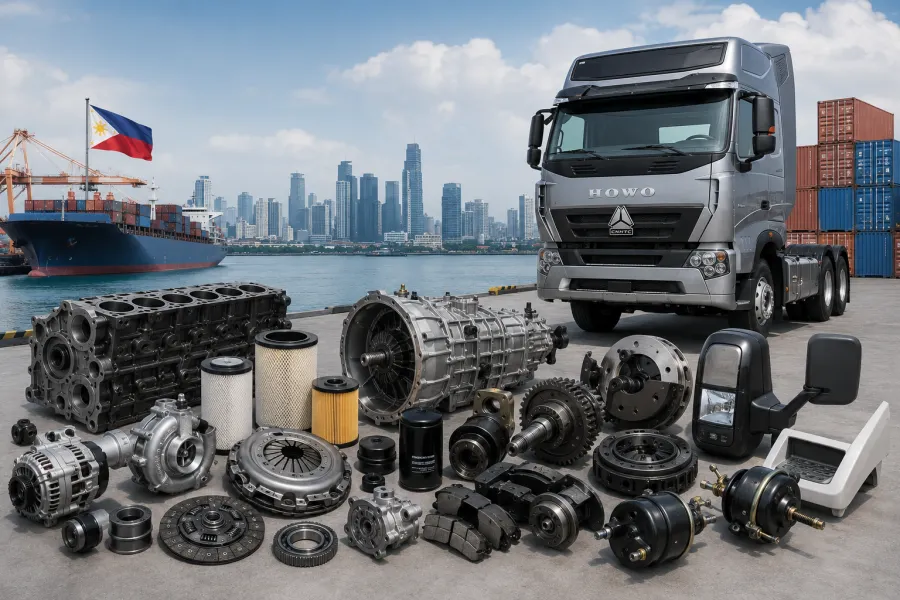
SINOTRUK HOWO parts can be supplied from China for Philippine repair workshops, spare-parts dealers, construction companies, logistics fleets, importers, wholesalers and resellers. For buyers searching for SINOTRUK HOWO parts in the Philippines, the commercial focus should be accurate identification, suitable quality selection, safe export packing and destination-specific freight planning. Mixed parts orders may also be discussed when buyers need several product categories in one shipment.
The correct purchasing decision depends on the truck’s actual configuration, the installed engine, gearbox and axle assemblies, the operating environment and the final delivery location. “HOWO,” “HOWO 371” or a truck photo is not enough to guarantee compatibility.
HOWO PARTS handles B2B wholesale and export inquiries from China. This does not imply a warehouse, local inventory, branch, service centre or technical team in the Philippines. Product availability, fitment, quality option, packing, lead time and freight must be checked against the buyer’s actual itemized list.
Quick Answer
Philippine businesses can source SINOTRUK HOWO truck parts wholesale from China, including cabin, electrical, brake, engine, gearbox, clutch, cooling, suspension and maintenance components. Before quotation, send the exact part number, quantity, VIN or chassis number, truck model, relevant assembly nameplates and clear old-part photos.
For cabin and electrical products, confirm the left-hand-drive cab version, installation side, lamp design, mirror bracket, connector shape, pin count, voltage and cable length. For freight planning, provide the final island, province, city, receiving port and required inland-delivery scope. International arrival in the Philippines may not be the final destination of the parts.
Practical recommendation: Use one itemized spreadsheet for the complete inquiry. Give every line its own part number, description, quantity, quality option, truck or assembly reference, photo reference and remarks. This is more reliable than sending disconnected screenshots through chat.
Where Are HOWO Truck Parts Used in the Philippines?
HOWO parts inquiries in the Philippines can come from workshops servicing mixed truck configurations, dealers building fast-moving stock, construction fleets operating dump trucks and support vehicles, regional logistics operators and importers consolidating multiple product categories.
The Philippine Statistics Authority’s preliminary 2025 domestic trade statistics recorded 60.19 million tonnes of domestic trade. Water accounted for 53.0% of volume and road for 47.0%. In value terms, road accounted for 54.0% and water for 45.9%. These data support the commercial importance of both road transport and inter-island cargo movement, but they do not establish the number or market share of HOWO trucks.
Construction is another relevant procurement setting. The Philippine Statistics Authority’s 2025 building-permit statistics recorded 181,832 constructions with a combined value of PHP 601.42 billion. Non-residential construction accounted for PHP 278.65 billion. These figures show active construction activity; they do not directly measure truck demand.
| Buyer type | Typical application | Parts priority | Main ordering risk |
|---|---|---|---|
| Repair workshop | Diagnosis and repair of different HOWO configurations | Electrical, cabin, brake, clutch, filters and repair kits | Ordering from appearance or a general model name |
| Parts dealer or reseller | Fast-moving stock for workshops and fleets | Lamps, mirrors, sensors, filters, brake parts, belts, hoses and small kits | Buying too many slow-moving SKUs without local sales records |
| Construction company | Dump trucks, mixers and project-support vehicles | Brakes, clutch, suspension, cooling, filters and cab repair parts | Assuming all trucks in the fleet share the same assemblies |
| Logistics fleet | Regional road transport and cargo support | Scheduled filters, brakes, clutch, cooling, electrical and cab parts | Failing to plan stock around actual replenishment time |
| Importer or wholesaler | Mixed-category procurement and distribution | Item verification, quality control, labelling, packing and freight | Quoting freight without a final island, city or port |
| Mining or quarry operator | Selected haulage and site-support applications | Filtration, cooling, braking, wheel-end and suspension parts | Applying a general mining specification without assembly data |
Mining and quarry requirements may be included where relevant, but they should not define the whole Philippine article. The Mines and Geosciences Bureau publishes regional reports covering metallic and non-metallic operations, including the Central Visayas mineral-industry reports. A quotation still needs the actual vehicle and installed-assembly information.
How Philippine Operating Conditions Affect Parts Planning
The Philippines has a tropical and maritime climate. PAGASA states that average monthly relative humidity ranges from 71% to 85%, while the rainy season generally runs from June to November. PAGASA also notes that typhoons materially influence rainfall, humidity and cloudiness. See the official PAGASA climate overview.
For buyers, these conditions justify closer inspection of electrical sealing, corrosion, rubber parts, wipers, lamps, connectors and moisture-sensitive packing. Climate alone cannot predict the service life of a part; route, maintenance, installation, load, product specification and vehicle condition remain important.
| Operating condition | Systems affected | Inspection focus | Purchasing response |
|---|---|---|---|
| High humidity and rain | Connectors, sensors, lamps, starters, alternators and cab seals | Corrosion, damaged seals, water entry and loose terminals | Confirm plug, pin count, voltage, cable length and sealing design |
| Construction dust | Air intake, filters, cooling system, brakes and wheel ends | Clogged elements, leaking hoses, radiator contamination and seal wear | Match filters by number and dimensions; inspect the complete intake and cooling path |
| Rough project or quarry roads | Suspension, steering, wheel ends and chassis parts | Bushings, U-bolts, joints, bearings and hub seals | Confirm axle, position, dimensions, thread and mounting points |
| Stop-start urban or regional work | Clutch, brakes, cooling and electrical systems | Wear patterns, heat, air-system condition and charging performance | Build a preventive list from maintenance history rather than a generic package |
| Coastal or port-adjacent handling | Exposed metal, electrical parts and packaging | Corrosion and moisture exposure | Use suitable anti-rust or moisture protection for the actual product |
| Inter-island replenishment | Fast-moving maintenance and repair items | Consumption rate and replenishment time | Set safety stock from service records and realistic delivery intervals |
Tropical conditions do not create a special universal “Philippines specification” for every HOWO part. The correct response is stronger identification, inspection and stock planning.
Fast-Moving HOWO Parts for Workshops and Dealers
Workshops and dealers should begin with their own repair orders and sales records. A practical stock list normally gives priority to products with repeat demand, clear identification and manageable inventory value rather than expensive assemblies that may remain unsold.
Cabin, Lighting and Visibility Parts
Philippine workshops and dealers may receive inquiries for:
- headlamps, tail lamps, fog lamps and turn-signal lamps;
- side mirrors, wide-angle mirrors, mirror arms and mirror glass;
- wiper motors, linkages, arms and blades;
- door locks, handles, hinges and window regulators;
- cab mounts, tilt components and weather strips;
- bumpers, grilles, steps and selected exterior panels.
Review the HOWO cabin spare parts range when preparing a cab-repair inquiry. Every lamp, mirror and panel should still be checked against the cab model, production version, mounting layout and installation side.
Electrical and Sensor Parts
Electrical inquiries may cover:
- starters and alternators;
- relays, switches and fuse-box components;
- speed, pressure, temperature and ABS sensors;
- headlamp and tail-lamp assemblies;
- wiring connectors and selected harness components;
- wiper and cab electrical components.
Use the HOWO electrical parts page as a category reference. For accurate matching, show the connector, pin arrangement, label, voltage, cable length and mounting position.
Maintenance, Brake and Driveline Parts
Fast-moving orders may also include:
- engine-oil, fuel and air filters;
- air-dryer cartridges;
- belts, tensioners, hoses, gaskets and seals;
- brake drums, shoes, chambers, valves and slack adjusters;
- clutch discs, pressure plates and release bearings;
- water pumps, thermostats and cooling hoses;
- bearings, hub seals, bushings and selected repair kits.
| Stock group | Example products | Typical buyer | Minimum identification data |
|---|---|---|---|
| Lamps and mirrors | Headlamp, tail lamp, side mirror, mirror arm | Workshop or dealer | Cab version, LH/RH position, mounting points and photos |
| Electrical parts | Sensor, relay, switch, starter, alternator | Workshop, fleet or dealer | Part number, voltage, plug, pin count and label |
| Filters and service parts | Oil, fuel and air filters, belts and hoses | Fleet, workshop or dealer | Filter number, dimensions, engine model and belt markings |
| Brake and air parts | Drum, shoe, chamber, valve, air-dryer cartridge | Construction fleet or workshop | Axle, brake size, valve number, ports and position |
| Clutch parts | Disc, pressure plate, release bearing and booster | Workshop or fleet | Diameter, spline count, gearbox and part number |
| Cooling parts | Water pump, thermostat, radiator, fan and hose | Fleet or workshop | Engine model, dimensions, connection positions and old part |
| Small repair kits | Seals, bearings, bushings and hardware kits | Workshop or dealer | Assembly model, kit contents, dimensions and reference number |
A broader overview is available through the HOWO truck parts page and the HOWO parts catalog.
Why LHD Cab, Lamp, Mirror and Connector Details Matter
LHD means the steering wheel and primary driving controls are on the left side of the cab. RHD means they are on the right. Republic Act No. 8506 bans the importation, registration and operation of right-hand-drive vehicles on Philippine public roads, subject to limited legal exceptions. The Philippine road-market baseline should therefore be treated as LHD. Buyers can review the text of Republic Act No. 8506 in the Supreme Court E-Library.
The LHD baseline does not remove the need for verification. Cab components can still vary by model, production period, dashboard version, connector and mounting layout.
Confirm These Details Before Ordering
- cab model and exterior front view;
- dashboard and steering-column position;
- left or right installation side;
- lamp housing shape and mounting points;
- mirror type, bracket and heating function;
- wiper arrangement and linkage design;
- connector shape and pin count;
- voltage and cable length;
- stamped, cast or labelled part number.
Avoid asking only for an “LHD headlamp” or “HOWO mirror.” LHD identifies the general driving configuration, not the complete component specification.
How to Confirm the Correct HOWO Part Number
Compatibility should be checked before unit-price comparison, order approval and packing. A lower-priced wrong part can cause repeat freight, delayed repairs and additional handling costs.
Recommended Verification Sequence
| Priority | Evidence to provide | What it can confirm | Limitation |
|---|---|---|---|
| 1 | Exact part number and readable markings | Component reference and possible version | Numbers may be incomplete, superseded or supplier-specific |
| 2 | VIN or chassis number | Original vehicle configuration | May not show later modifications |
| 3 | Engine, gearbox or axle nameplate | Installed major assembly | Plate must be complete and readable |
| 4 | Truck model, year and axle configuration | General vehicle variant | Commercial names such as “HOWO 371” are not complete identifiers |
| 5 | Clear old-part photos | Shape, connection and mounting layout | Similar appearance does not guarantee fitment |
| 6 | Dimensions, teeth, splines, pins and voltage | Technical comparison of similar parts | Measurements and counts must be accurate |
| 7 | Installation position | Front/rear, LH/RH and installed location | Position alone does not identify the component |
| 8 | LHD cab and dashboard details | Cab, lamp, mirror, wiper and interior variants | Still requires part-specific evidence |
For engine components, provide the engine model and serial number. Buyers can review the HOWO engine parts range before sending the list.
For shafts, synchronizers, gears and internal transmission components, provide the gearbox nameplate, exact model, tooth or spline counts and old-part markings. See the HOWO gearbox parts category for reference.
For brake parts, confirm axle, brake size, air-valve number, port layout and installation position. Review the HOWO brake parts category when preparing a brake-system list.
Photo Requirements
Good identification photos should show:
- the complete old component from several angles;
- all labels, cast numbers and stamped markings;
- mounting holes, threads, ports and connection points;
- plugs, sockets and pin arrangements;
- dimensions shown with a ruler or vernier caliper;
- the component’s original installation location;
- the relevant engine, gearbox or axle nameplate.
A VIN can support identification, but it cannot guarantee every internal or modified component. The installed assembly and old part may be more relevant where a truck has been rebuilt or altered.
Original, OEM-Quality and Aftermarket HOWO Parts
Choose the quality tier according to component criticality, specification, traceability, duty cycle, budget and end-customer requirements. Product labels alone do not prove origin or performance.
| Quality option | Commercial meaning | Evidence to request | Main risk |
|---|---|---|---|
| Original | Product represented as coming through an original production or brand supply channel, subject to item-specific evidence | Part number, manufacturer/source information, packaging, traceability and warranty terms | Accepting an unsupported “original” claim |
| OEM-quality | A commercial quality description linked to a stated manufacturer and specification; not automatically the same as an original part | Manufacturer, material/specification, test information where relevant, traceability and warranty | Assuming the term proves identity or equivalence |
| Aftermarket | Replacement product made outside the original supply channel, with quality varying by maker and grade | Maker, material, specification, sample or test evidence and warranty terms | Selecting by price or appearance alone |
Brake, steering, fuel-system and internal-engine components normally justify stronger traceability and specification controls. Lamps, mirrors and selected cab parts still require accurate fitment, protective packing and consistent quality.
Dealers should separate the quality tier line by line in quotations and stock records. Do not combine different grades under one vague description.
How Mixed HOWO Parts Orders Are Consolidated
A mixed-SKU order combines different part numbers and product categories into one commercial shipment. This can suit Philippine dealers, workshops and importers that need cabin, electrical, brake, engine, gearbox and maintenance products at the same time.
Mixed orders require item-level control:
- Prepare one approved SKU list with part number, description, quantity and quality tier.
- Resolve missing or conflicting identification data before purchasing.
- Confirm availability and acceptable alternatives line by line.
- Obtain buyer approval before changing a part number, manufacturer or grade.
- Label each inner package and outer carton clearly.
- Separate left/right and front/rear components.
- List the contents of repair kits.
- Match carton or case numbers to the final packing list.
Substitutions should not be made because two products look similar. Any proposed change should be documented and approved before packing.
Practical recommendation: Ask for a final pre-packing list that shows the approved part number, description, quantity, quality tier and package number. This gives your receiving team a usable control document when a mixed shipment reaches the Philippines.
Export Packing for Lamps, Mirrors, Electrical and Heavy Parts
Packing should be chosen by weight, fragility, moisture sensitivity, surface finish and handling risk. A mixed shipment should not place precision or fragile products under concentrated loads from brake drums, flywheels or other heavy parts.
| Part type | Main shipping risk | Recommended packing control |
|---|---|---|
| Lamps and mirrors | Breakage, scratching and mounting damage | Rigid separation, individual cushioning and protected cartons or cases |
| Sensors and electrical parts | Moisture, static, connector damage and mixing | Sealed individual packing, connector protection and clear labels |
| Injectors and precision fuel parts | Impact and contamination | Individual sealed protection, cushioning and clean handling |
| Filters | Moisture and crushing | Dry inner packing and reinforced cartons |
| Brake drums, flywheels and heavy metal parts | Impact and concentrated weight | Reinforced pallet or wooden case with load separation |
| Cab panels and plastic parts | Bending, scratching and deformation | Surface protection, rigid support and separation from heavy cargo |
| Seal kits and small components | Missing pieces and SKU mixing | Individual bags, kit labels and item-count control |
Available arrangements may include export cartons, pallets, wooden cases, anti-rust protection and moisture barriers. Wood-packaging requirements should be checked for the actual shipment and importing arrangement before dispatch.
Shipping HOWO Parts to Philippine Islands and Cities
The international arrival point may not be the final place where the trucks operate or where the buyer stores the parts. A quotation that says only “Philippines” does not provide enough information for reliable freight planning.
Provide:
- final island and province;
- final city, warehouse or project location;
- preferred or required receiving port;
- port-to-port or inland-delivery scope;
- consignee and customs-broker details;
- freight-forwarder warehouse information, if used;
- receiving capability for pallets or heavy wooden cases.
| Destination information | Why it is required | Quotation impact |
|---|---|---|
| Final island and province | Identifies whether domestic transfer may be required | Affects route, transshipment and onward movement |
| Final city or project location | Defines the actual receiving point | Affects inland scope and delivery responsibility |
| Receiving port | Establishes the intended international or domestic gateway | Affects routing and destination charges |
| Freight basis | Clarifies port-to-port, airport, warehouse or inland scope | Prevents comparison of quotations with different responsibilities |
| Consignee and broker details | Supports document and import planning | May affect document format and pre-shipment checks |
| Forwarder warehouse | Identifies any nominated consolidation point | Affects origin delivery and booking instructions |
| Package-handling capability | Confirms whether heavy cases or pallets can be unloaded | Affects packing design and delivery equipment |
LCL or FCL
Less-than-container-load shipping may suit some smaller mixed wholesale orders. Full-container-load shipping may be relevant for larger, denser or difficult-to-handle cargo. Neither method is automatically cheaper or faster.
Compare the same commercial scope:
- origin charges;
- ocean freight;
- consolidation or deconsolidation;
- transshipment;
- destination charges;
- domestic transfer;
- inland delivery;
- package dimensions and gross weight.
Air freight may be considered for selected small urgent parts, but cost, chargeable weight, cargo restrictions and customs handling should be checked against the actual shipment. Do not assume a fixed route or transit time.
Import, AHTN and Form E Checks
The Philippine importer or appointed customs broker should verify importer eligibility, AHTN/HS classification, duties, taxes, permits, product restrictions and current document requirements before shipment.
The Bureau of Customs lists example documents for non-regular importers that include an air waybill or bill of lading, commercial invoice, packing list, entry declaration and import permit where applicable. Requirements vary by importer type and shipment. Buyers should check the current Bureau of Customs AMO guidance and obtain professional confirmation for the actual import.
The Philippines uses the ASEAN Harmonized Tariff Nomenclature, or AHTN, for product classification. Different HOWO spare parts can fall under different codes. Filters, bearings, brake parts, engine components, electrical products and cab parts should not be placed under one blanket code. The Philippine Tariff Commission’s AHTN 2022 Tariff Book and Philippine Tariff Finder are official references.
ACFTA and Form E
For qualifying China-origin goods, an importer may examine possible preferential treatment under the ASEAN–China Free Trade Area. The Philippine Tariff Finder’s ACFTA page states that Certificate of Origin Form E is required to claim applicable ACFTA preferential tariffs.
Form E does not by itself guarantee a lower duty. Eligibility depends on:
- the exact AHTN classification;
- the applicable tariff schedule;
- the product-specific rule of origin;
- manufacturing and origin evidence;
- correct document completion;
- current Philippine customs acceptance.
The Philippine importer or customs broker should confirm eligibility before shipment documents are finalized.
Information Required for a Wholesale Quotation
Send a structured request rather than a list of general part names.
| RFQ field | What to provide | Why it matters |
|---|---|---|
| Part identification | Part number, description and readable markings | Defines the requested SKU |
| Quantity | Required quantity for each item | Supports price, availability and packing |
| Vehicle identity | VIN/chassis, truck model, year and axle configuration | Supports vehicle-level verification |
| Installed assemblies | Engine, gearbox and axle model/nameplate | Supports assembly-specific matching |
| Old-part evidence | Photos, dimensions, plug, pins, teeth and splines | Resolves incomplete or conflicting references |
| Cab details | LHD configuration, cab version and LH/RH position | Supports cabin, mirror, lamp, wiper and dashboard matching |
| Quality option | Original, OEM-quality or aftermarket requirement | Defines the commercial comparison |
| Destination | Final island, province, city, port and freight scope | Defines routing and quotation responsibility |
| Packing requirements | Labelling, cartons, pallet, wooden case or special protection | Defines export preparation |
| Importer requirements | Consignee, broker and document instructions | Supports compliant document preparation |
Quotation Process
- Send the complete itemized list and quantities.
- Review missing, unclear or conflicting identification information.
- Confirm truck and installed-assembly references.
- Select the quality option for each item.
- Approve any proposed alternative in writing.
- Confirm packing, labelling and the final Philippine destination.
- Prepare the quotation for the approved product and freight scope.
Use this copy-ready inquiry format:
- Part number / description:
- Quantity:
- Truck model and year:
- VIN / chassis number:
- Engine / gearbox / axle model:
- Cab version and installation side:
- Required quality option:
- Final island, city and receiving port:
- Required freight scope:
Frequently Asked Questions About SINOTRUK HOWO Parts in the Philippines
Can You Supply SINOTRUK HOWO Parts Wholesale to the Philippines?
Yes. HOWO PARTS accepts B2B wholesale inquiries from Philippine workshops, dealers, construction companies, logistics fleets, importers, wholesalers and resellers. Supply and export preparation are arranged from China, subject to identification, quantity, quality requirement and availability.
Do You Have a Warehouse or Local Inventory in the Philippines?
This article describes wholesale supply from China. It does not claim a Philippine warehouse, branch, local inventory, service centre or technical team. Availability and lead time are checked against the actual item list.
Can I Combine Cabin, Electrical, Brake, Engine and Gearbox Parts?
Mixed-SKU orders may be discussed. Each part number, quantity, quality tier and packing requirement must be confirmed before consolidation. Fragile, precision, moisture-sensitive and heavy products may require separate protection.
Is “HOWO 371” Enough to Identify a Part?
No. “HOWO 371” is a broad commercial description and does not identify every engine, gearbox, axle, cab, brake or electrical component. Provide the VIN, relevant assembly nameplate, exact part number and old-part evidence.
Is the Philippines an LHD or RHD Market?
The normal road-market configuration is LHD because Republic Act No. 8506 bans the importation, registration and operation of right-hand-drive vehicles on public roads, subject to limited exceptions. Buyers should confirm the installed cab and specific component rather than ordering an RHD variant without verified need.
Why Do Plug Type and Pin Count Matter?
Sensors, switches, lamps and other electrical products can have similar housings but different connectors, wiring or signal specifications. Show the plug shape, pin arrangement, voltage, cable length, label and mounting position.
Can a VIN Confirm Every Spare Part?
No. A VIN can support vehicle identification, but later modifications and internal assembly parts may require engine, gearbox or axle nameplates, dimensions, tooth counts, connector details or old-part photos.
Which Parts Should a Philippine Workshop or Dealer Stock First?
Use actual repair orders and sales history. Common planning groups include filters, belts, hoses, lamps, mirrors, switches, sensors, brake parts, air-system products, clutch parts and selected small repair kits. Do not build stock from a generic list alone.
What Is the Difference Between Original, OEM-Quality and Aftermarket Parts?
These terms describe different sourcing and specification propositions. Compare the stated manufacturer, traceability, technical specification, packaging, test evidence where relevant and warranty terms. Do not choose from the label or unit price alone.
How Should Lamps, Mirrors and Sensors Be Packed?
Use individual protection, rigid separation, cushioning and clear part-number labels. Keep fragile and electrical items away from concentrated loads created by brake drums, flywheels and other heavy components.
Is LCL or FCL Better for a Philippine Order?
It depends on cargo volume, weight, density, package dimensions, route and destination charges. Compare LCL and FCL using the same final destination and service scope. Neither is automatically cheaper or faster.
Why Must I Provide the Final Island and City?
The international arrival point may not be the final receiving location. The final island, province, city, port and inland scope affect route selection, domestic transfer, handling and freight responsibility.
Does Form E Guarantee Preferential Duty?
No. Form E is required to claim applicable ACFTA preferential tariffs, but acceptance depends on the exact AHTN code, rules of origin, supporting evidence, document completion and current customs requirements.
How Can I Request a Quotation?
Email the itemized list to [email protected]. Include part numbers, quantities, VIN or chassis number, truck and assembly details, quality requirements, photos where necessary and the final Philippine destination.
Request a SINOTRUK HOWO Parts Quotation
Send your inquiry to [email protected] with:
- part number and description;
- quantity for each item;
- truck model, year and axle configuration;
- VIN or chassis number;
- engine, gearbox and axle model;
- readable nameplate and old-part photos;
- connector, pin, voltage and cable details where relevant;
- LHD cab version and LH/RH installation side;
- preferred quality option;
- final Philippine island, city and receiving port;
- packing, labelling and freight requirements.
Mixed orders may be discussed after the SKU list has been reviewed. Compatibility, availability, packing, freight and lead time will be evaluated for the actual items and destination.