
Quick Answer
Before purchasing HOWO Parts in Guinea, confirm the part number, VIN or chassis number, truck model, engine model, gearbox model, front and rear axle models, axle ratio where relevant, dimensions, spline details, old part photos, required quantity, working application, and destination.
Bauxite transport, quarry haulage, mining-site logistics, and rough-road construction work place greater stress on axle, suspension, brake, gearbox, engine mounting, wheel-end, and cooling systems. Heavy technical parts cannot be identified reliably by product name or appearance alone.
Your purchasing priorities should normally include:
- Axle and differential parts
- Suspension and chassis parts
- Brake and air-system parts
- Gearbox components
- Engine repair parts
- Wheel hubs and bearings
- Cooling system parts
- Fast-moving maintenance items
- Durable export packing
Dealers, mining fleet operators, repair workshops, quarry transport companies, and importers can combine fast-moving items with selected heavy repair components in practical mixed spare parts orders.
Practical recommendation: Divide your Guinea order into three groups: fast-moving maintenance stock, heavy repair components, and high-value technical parts. Confirm every axle, differential, gearbox, shaft, and engine repair item separately before adding it to the final purchase order.
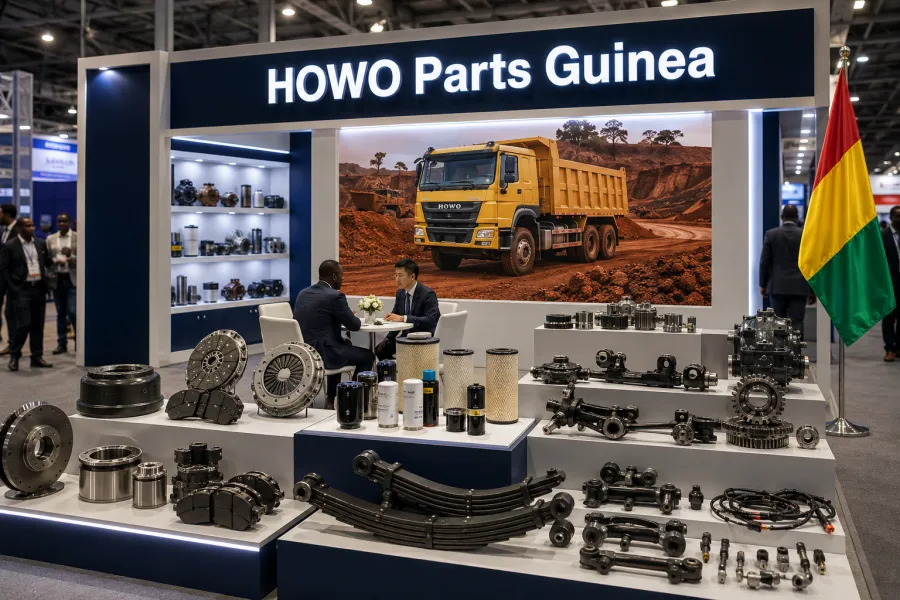
HOWO spare parts supply and export support for Guinea bauxite mining fleets, quarry transport operators, heavy-duty repair workshops, dealers, and importers.
Why HOWO Parts Demand in Guinea Is Different
The purchasing logic for heavy-duty truck parts in Guinea is closely connected to mineral transport, mine-support logistics, quarry work, construction projects, and long operating cycles away from major repair facilities.
According to the EITI Guinea country profile, the extractive sector represented a major share of Guinea’s exports in 2022, with bauxite among the country’s principal exported minerals. This industrial structure helps explain why mining-related transport and supporting fleets create substantial demand for heavy-duty maintenance and repair parts.
Bauxite transport vehicles do not face the same parts-consumption pattern as ordinary urban delivery trucks. Their work can involve:
- Repeated loading at mining or stockpile areas
- High payloads
- Frequent braking under load
- Rough or unpaved access roads
- Dust, mud, vibration, and impact
- Long working shifts
- Limited access to immediate technical support
- High downtime cost when a truck cannot return to service
These conditions make axle, suspension, brake, driveline, gearbox, and engine repair parts particularly important.
A worn suspension bushing or torque rod may initially appear to be a minor maintenance issue. If it is not replaced early, the resulting movement can increase stress on brackets, axle positioning, tyres, propeller shafts, and other chassis components.
The same principle applies to wheel bearings, hub seals, differential parts, and gearbox bearings. Delayed replacement can turn a manageable repair into a larger assembly failure.
Mining support fleets also need practical preventive stock. A truck operating far from a major workshop may remain inactive for days if a small but essential part is unavailable. Filters, belts, hoses, brake valves, chambers, sensors, bearings, seals, lamps, and clutch components can therefore carry greater operational value than their unit price suggests.
Repair workshops serving mining-related customers face another difficulty: similar HOWO trucks may use different axle models, axle ratios, gearbox versions, engine configurations, suspension brackets, and brake components.
A part that looks correct may still be unsuitable because of differences in:
- Shaft length
- Spline count
- Gear tooth count
- Bolt pattern
- Bearing size
- Differential ratio
- Installation side
- Connector type
- Internal specification
Dealers must balance two different inventory requirements.
The first is fast-moving stock that supports frequent maintenance and workshop sales. The second is low-frequency, high-value technical stock used for confirmed axle, gearbox, differential, or engine repairs.
Holding too many expensive assemblies can reduce cash flow and inventory turnover. Holding no technical repair stock can cause lost sales when mining and quarry customers need urgent support.
The strongest stock plan therefore combines:
- High-frequency maintenance items
- Common heavy repair components
- Selected high-value technical parts
- Order-based assemblies
- Strong confirmation procedures
- Durable export packing
HOWO Truck Applications and Parts Priorities in Guinea
Parts selection should begin with the truck’s actual job. Two HOWO dump trucks may use similar basic systems, but the truck carrying bauxite on mine roads may consume parts differently from a construction vehicle operating near an urban project.
| Application | Typical Truck Type | Operating Pressure | Priority Spare Parts |
|---|---|---|---|
| Bauxite transport | Heavy-duty HOWO dump truck, mining tipper, tractor and trailer combination | Repeated high-payload cycles, mine-road vibration, braking under load, long operating hours | Axle parts, differential parts, brake drums, brake chambers, leaf springs, torque rods, wheel bearings, gearbox parts, and cooling components |
| Mining service logistics | Cargo truck, fuel support truck, water truck, maintenance support vehicle | Frequent travel between workshops, mining areas, stockyards, and remote service points | Filters, belts, hoses, electrical parts, wheel-end parts, suspension components, clutch parts, and engine maintenance items |
| Quarry haulage | Dump truck, aggregate carrier, heavy cargo truck | Short heavy-load cycles, rough access roads, dust, impact, and repeated tipping | Brake parts, suspension bushings, U-bolts, leaf springs, hubs, bearings, engine mounts, and clutch components |
| Construction material transport | Dump truck, mixer truck, water truck, cargo truck | Project-site vibration, repeated loading, uneven roads, stop-and-go work | Brake chambers, clutch parts, cooling items, suspension parts, cabin hardware, lamps, and maintenance filters |
| Long-distance heavy-load delivery | Tractor truck, cargo truck, trailer combination | Extended operating hours, variable roads, high dependence on preventive maintenance | Gearbox bearings, clutch components, water pumps, radiators, belts, hoses, brake valves, sensors, and wheel-end seals |
| Workshop repair and dealer resale | Mixed HOWO 371, A7, T7H, TX, NX, and older trucks | Different model years, engines, gearboxes, axles, cabins, and technical configurations | Fast-moving service stock, confirmed axle parts, brake components, gearbox repair parts, engine kits, electrical items, and selected assemblies |
Bauxite transport creates strong demand for load-bearing and driveline components because payload, road impact, and repeated braking act on the truck at the same time.
Mining service logistics vehicles may carry lighter loads but often operate across long internal routes. Their purchasing priorities may shift toward filters, cooling components, wheel-end parts, electrical items, clutch parts, and scheduled maintenance products.
Quarry trucks frequently operate over shorter routes, but repeated loading and rough access roads can accelerate wear in suspension, braking, wheel-end, and chassis systems.
Long-distance heavy-load vehicles need reliable cooling, gearbox, clutch, brake, and wheel-end performance because a roadside failure can create recovery costs, cargo delays, and missed delivery commitments.
Workshops and dealers need broader coverage, but every technical component must be connected to a known truck configuration or customer requirement.
How Rough Roads and Heavy Loads Affect Parts Selection
Rough-road operation changes more than the expected replacement interval. It also changes which quality grade, confirmation process, and stock level make commercial sense.
Repeated Heavy-Load Cycles
A mining or quarry truck does not simply carry a heavy load once. It may repeat the same loaded route many times during a working shift.
This repeated cycle places stress on:
- Axle shafts
- Differential gears
- Wheel hubs
- Hub bearings
- Brake drums
- Leaf springs
- Torque rods
- Suspension brackets
- Gearbox shafts
- Engine and gearbox mounts
The purchasing implication is clear: load-bearing and driveline parts should not be chosen only by the lowest unit price.
If the truck has a high downtime cost, original or reliable OEM-quality components usually provide a stronger commercial case for critical systems.
Uneven and Unpaved Mining Roads
Uneven roads produce constant suspension movement and chassis vibration.
This can accelerate wear in:
- Torque rod bushings
- Leaf spring pins
- U-bolts
- Brackets
- Shock absorbers
- Engine mounts
- Gearbox mounts
- Propeller shaft joints
- Wheel bearings
- Hub seals
A workshop should not inspect these components individually without checking the connected system.
For example, a worn torque rod bushing may allow excessive axle movement. If the truck continues working, the damage can spread to brackets, tyres, propeller shaft alignment, and other suspension components.
Dust, Mud, Vibration, and Impact
Dust increases filtration demand and can affect electrical connections, moving joints, and cooling surfaces.
Mud and water exposure may affect:
- Hub seals
- Bearings
- Electrical connectors
- Brake components
- Wiring joints
- Sensors
- Lamp connections
Vibration and repeated impact can loosen mounting hardware and damage brackets, lamps, mirrors, wiring supports, and cabin components.
Your order should therefore include both the failed part and the related fastening, sealing, or mounting items where necessary.
Frequent Braking Under Load
Heavy trucks working on mine and quarry roads may require repeated braking while loaded.
This increases demand for:
- Brake drums
- Brake shoes
- Brake linings
- Brake chambers
- Relay valves
- Foot brake valves
- Slack adjusters
- Air dryer parts
- Air pipes and fittings
Brake drums are heavy and costly to replace through emergency freight. Dealers serving mining customers should identify the most common confirmed specifications and maintain practical stock levels.
High Stress on Axle and Suspension Components
Axle and suspension damage often develops gradually.
Common warning signs may include:
- Abnormal tyre wear
- Wheel-end noise
- Oil leakage
- Excessive axle movement
- Chassis vibration
- Steering instability
- Uneven vehicle height
- Repeated suspension bushing failure
Early replacement of bearings, seals, bushings, brackets, and torque rod components can help prevent more expensive damage to hubs, shafts, differentials, and axle housings.
Long Working Hours Away from Major Repair Facilities
Remote operation changes the value of stock availability.
A low-cost sensor, seal, bearing, valve, or hose may stop a high-value truck if no replacement is available. Mining fleets should therefore build maintenance stock according to downtime risk rather than product price alone.
Useful preventive stock normally includes:
- Filters
- Belts
- Hoses
- Seals
- Bearings
- Brake valves
- Brake chambers
- Sensors
- Switches
- Lamps
- Clutch control parts
- Wheel-end components
Risk of Secondary Damage
Operating with worn parts can increase total repair cost.
Examples include:
- A worn wheel bearing damaging the hub or shaft
- A leaking axle seal contaminating brake components
- A worn synchronizer damaging gearbox gears
- A loose suspension bracket damaging the chassis mounting area
- A failed engine mount increasing vibration in hoses and wiring
- A weak cooling component causing engine overheating
Your maintenance plan should focus on early detection, system-based inspection, and coordinated parts purchasing.
Common HOWO Spare Parts Needed by Guinea Buyers
Guinea orders often combine fast-moving service parts with heavy repair items and high-value technical components.
| Parts System | Common Items | Main Application | Required Confirmation |
|---|---|---|---|
| Axle and driveline | Wheel hubs, bearings, differential gears, half shafts, through shafts, cross shafts, final-drive parts | Bauxite transport, quarry haulage, heavy-load logistics | Axle model, axle ratio, installation position, casting number, shaft dimensions, spline details, and old part photos |
| Suspension and chassis | Leaf springs, torque rods, bushings, brackets, U-bolts, shock absorbers, balance shaft parts | Mining roads, quarry routes, construction projects | Axle configuration, load condition, dimensions, bolt pattern, installation side, and bracket photos |
| Brake system | Brake drums, shoes, chambers, valves, linings, air dryers, slack adjusters | Loaded mining trucks, dump trucks, construction vehicles | Drum dimensions, axle position, valve ports, thread size, chamber type, part number, and photos |
| Engine repair | Pistons, liners, bearings, gasket kits, turbochargers, injectors, oil pumps, water pumps | Mining fleet overhaul, workshop repair, construction fleets | Engine model, engine number, part number, repair scope, dimensions, and old component photos |
| Gearbox system | Gears, shafts, synchronizers, bearings, housings, selectors, seals, repair kits | Heavy-load transport, mining support, workshop overhaul | Gearbox model, gear position, tooth count, spline details, shaft length, and nameplate photo |
| Cooling system | Radiators, intercoolers, fans, water pumps, thermostats, hoses, expansion tanks | Long shifts, loaded operation, construction and mining support | Truck model, engine model, mounting points, dimensions, hose layout, and old part photos |
| Cabin and body | Lamps, mirrors, steps, handles, locks, bumpers, grilles, dashboard items | Workshop repair, construction damage, dealer resale | Cab version, LHD or RHD, mounting holes, connector type, bracket shape, and product photos |
| Electrical system | Sensors, switches, starters, alternators, relays, wiring, connectors, control components | Fleet maintenance, electrical troubleshooting, workshop stock | Part number, voltage, connector shape, pin count, wiring position, and label photo |
Axle and Driveline Parts
Axle and driveline parts require stricter technical confirmation than routine maintenance products.
Common demand includes:
- Wheel hubs
- Hub bearings
- Differential gears
- Crown wheels and pinions
- Half shafts
- Through shafts
- Cross shafts
- Final-drive components
- Oil seals
- Differential bearings
- Propeller shaft joints
The axle model alone may not be enough. Axle ratio, casting number, installation position, shaft length, spline count, spline diameter, gear tooth count, and old part photos may also be necessary.
A differential gear set with the wrong ratio cannot be treated as an acceptable substitute even if the overall dimensions appear similar.
Suspension and Chassis Parts
Mining and quarry roads create regular demand for:
- Leaf springs
- Torque rods
- Bushings
- Suspension brackets
- U-bolts
- Shock absorbers
- Balance shaft components
- Spring pins
- Chassis mounting hardware
Heavy suspension items should be selected according to load condition and actual truck configuration.
When ordering brackets or torque rods, provide clear photos of the mounting points and measurements between hole centers.
Brake System Parts
Loaded trucks require consistent braking performance.
Common products include:
- Brake drums
- Brake shoes
- Brake linings
- Brake chambers
- Relay valves
- Foot brake valves
- Air dryers
- Slack adjusters
- Air pipes and fittings
The HOWO brake parts range should be checked using the axle position, truck configuration, part number, dimensions, and old part photos.
Similar-looking brake chambers and valves may use different port arrangements, thread sizes, strokes, or internal specifications.
Engine Repair Parts
Mining and heavy-load operation can create demand for both scheduled maintenance and major engine repair.
Common parts include:
- Pistons
- Piston rings
- Cylinder liners
- Main bearings
- Connecting rod bearings
- Gasket kits
- Cylinder head parts
- Turbochargers
- Injectors
- Oil pumps
- Water pumps
- Filters
- Belts and hoses
The available HOWO engine parts should be matched by engine model, engine number, part number, repair scope, and component dimensions.
An engine repair kit should not be ordered only by horsepower or a general engine family description.
Gearbox Parts
Gearbox repairs may require:
- Gears
- Main shafts
- Countershafts
- Input shafts
- Synchronizers
- Bearings
- Selector components
- Gearbox housings
- Oil seals
- Repair kits
Use the exact gearbox nameplate and old component references when reviewing HOWO gearbox parts.
Gear position, tooth count, spline count, shaft length, and bearing dimensions may be necessary for internal component confirmation.
Cooling, Cabin, and Electrical Parts
Long working hours increase the importance of cooling reliability.
Common cooling items include:
- Radiators
- Intercoolers
- Water pumps
- Fan blades
- Fan belts
- Thermostats
- Expansion tanks
- Hoses
- Temperature sensors
Cabin damage and vibration-related wear create demand for mirrors, lamps, steps, door hardware, bumpers, grilles, and dashboard components. These products should be matched through the correct HOWO cabin spare parts category and cab version.
Electrical parts may look identical from the front while using different rear connectors or pin arrangements.
When purchasing HOWO electrical parts, provide clear photos of:
- Product label
- Plug
- Pin layout
- Wiring position
- Mounting holes
- Rear housing
- Installation location
How Guinea Buyers Should Confirm HOWO Parts Before Ordering
Heavy technical parts require a structured confirmation process before quotation approval.
Part Number
Send all visible numbers, including:
- Printed labels
- Stamped numbers
- Casting numbers
- Gear markings
- Bearing references
- Manufacturer codes
Do not remove letters, prefixes, suffixes, spaces, or version codes.
VIN or Chassis Number
Provide the complete VIN or chassis number with a clear vehicle nameplate photo.
This helps identify the original truck configuration, but it may not replace direct confirmation of later-replaced axles, gearboxes, cabins, or other assemblies.
Truck Model
State the complete truck model and application.
Examples include:
- Mining dump truck
- Quarry dump truck
- Tractor truck
- Cargo truck
- Water truck
- Fuel support truck
- Construction vehicle
Engine Model
Engine confirmation is required for:
- Pistons
- Liners
- Bearings
- Gasket kits
- Injectors
- Turbochargers
- Pumps
- Sensors
- Cooling components
Gearbox Model
Send a clear gearbox nameplate photo.
Internal parts may also require:
- Gear position
- Tooth count
- Shaft length
- Spline count
- Spline diameter
- Bearing size
- Old part photos
Front and Rear Axle Models
Do not describe the component only as “front axle part” or “rear axle part.”
Provide:
- Axle nameplate
- Casting number
- Installation position
- Truck configuration
- Old part number
- Photos
- Measurements
Axle Ratio
Axle ratio is particularly important for differential and final-drive components.
A crown wheel and pinion set with an incorrect ratio may fit physically but will not provide the correct driveline operation.
Cab Version
Cab version is required for:
- Lamps
- Mirrors
- Grilles
- Bumpers
- Doors
- Dashboard parts
- Wiring components
- Steps
- Interior parts
LHD or RHD
Confirm the steering position when purchasing:
- Dashboard components
- Mirrors
- Wiper parts
- Steering-related items
- Selected wiring
- Cab panels
Old Part Photos
Provide photographs showing:
- Front
- Back
- Left side
- Right side
- Product label
- Casting number
- Gear teeth
- Splines
- Mounting holes
- Installation position
Casting Number
Casting numbers can help identify hubs, housings, brackets, gearbox components, differential parts, and other heavy metal items.
However, the casting number should be checked together with dimensions and vehicle configuration.
Mounting Holes
Provide:
- Number of holes
- Hole diameter
- Center-to-center distance
- Thread type
- Bracket orientation
- Installation photos
Shaft Length and Spline Details
For half shafts, through shafts, gearbox shafts, and driveline components, provide:
- Overall length
- Spline count
- Spline diameter
- Shaft diameter
- Thread details
- Installation side
- Old part photos
Connector and Plug Type
For electrical items, show:
- Connector shape
- Pin count
- Socket layout
- Wiring position
- Product label
- Mounting bracket
Quantity and Working Application
State whether the parts are for:
- One confirmed repair
- Mining fleet maintenance
- Workshop stock
- Dealer resale
- Quarry transport
- Construction work
- Emergency replenishment
The application helps determine the appropriate quality level and stock recommendation.
Destination and Forwarding Arrangement
Confirm:
- Destination port
- Freight forwarder
- Consignee information
- Forwarder warehouse
- Final destination
- Preferred shipping method
- Packing requirements
Practical recommendation: Confirm the axle model, axle ratio, gearbox model, shaft dimensions, spline details, gear tooth count, casting number, and multi-angle photos before shipment. Heavy technical parts are expensive to return, and a wrong axle or gearbox component can create additional downtime, freight, handling, and workshop costs.
Original, OEM, or Replacement HOWO Parts for Guinea Operations
Quality selection should follow the system risk, truck workload, repair value, and expected downtime cost.
| Quality Option | Recommended Application | Main Advantage | Buying Caution |
|---|---|---|---|
| Original parts | Critical mining trucks, major axle or gearbox repairs, engine overhauls, safety-related systems | Strong fitment confidence and stable specifications for high-risk repairs | Confirm authenticity, packaging, part number, and whether the quotation represents genuine original supply |
| OEM-quality parts | Long-term fleet maintenance, professional workshop repair, quarry fleets, dealer technical stock | Balanced cost and service performance when supplied by a reliable manufacturer | Request manufacturer identity, specifications, photos, and quality confirmation rather than accepting a vague “OEM” description |
| Reliable replacement parts | Selected maintenance items, cabin components, lamps, mirrors, simple electrical items, price-sensitive stock | Competitive pricing and wider market coverage for suitable non-critical applications | Avoid unknown low-grade products for axle, brake, engine, gearbox, steering, or load-bearing suspension systems |
Mining Fleets
Mining fleets should normally prioritize original or reliable OEM-quality parts for:
- Axles
- Differentials
- Brakes
- Suspension
- Gearboxes
- Engine internals
- Steering
- Wheel-end assemblies
The cost of another breakdown can exceed the initial price difference between quality grades.
Quarry Transport Operators
Quarry vehicles need dependable brake, suspension, wheel-end, clutch, and chassis parts.
Reliable OEM-quality products can provide a practical balance between purchase cost and durability when the manufacturer and specification are clear.
Construction Contractors
Construction contractors should separate critical and non-critical purchasing.
Original or OEM-quality components are more appropriate for safety, driveline, engine, and load-bearing systems. Reliable replacement products may suit selected cabin, lamp, mirror, body, and accessory applications.
Repair Workshops
Workshops can offer several quality options when customers understand:
- Product positioning
- Expected service life
- Application limits
- Price difference
- Warranty conditions
Each quoted line should identify the quality grade clearly.
Dealers and Resellers
Dealers may build multi-level inventory for different customer budgets.
However, original, OEM-quality, and replacement products should be stored, labeled, quoted, and invoiced separately.
Unclear quality descriptions create customer disputes and damage commercial trust.
Price-Sensitive Buyers
Lower purchase cost should not override system risk.
Price-sensitive replacement parts may be considered for selected:
- Lamps
- Mirrors
- Handles
- Cabin trim
- Simple maintenance products
- Non-critical accessories
Axle, brake, engine, gearbox, steering, and suspension parts should not be selected only by the lowest price.
Fast-Moving and High-Value HOWO Parts for Guinea Stock Planning
A mining-oriented inventory needs several stock layers rather than one general list.
High-Frequency Maintenance Stock
These products support scheduled servicing, daily workshop demand, and routine dealer sales:
- Oil filters
- Fuel filters
- Air filters
- Belts
- Hoses
- Sensors
- Switches
- Lamps
- Brake linings
- Clutch control parts
- Seals and gaskets
They usually justify regular replenishment because they move more frequently and can cover several common repair situations.
Heavy-Duty Repair Stock
These products have lower sales frequency but are important for mining, quarry, and heavy-load repair:
- Brake drums
- Brake chambers
- Wheel bearings
- Hub seals
- Suspension bushings
- Torque rod parts
- Leaf spring components
- U-bolts
- Wheel hubs
- Engine mounts
Their weight and urgent freight cost should be considered when setting stock levels.
High-Value Technical Stock
These parts should normally be linked to known truck configurations or confirmed customer demand:
- Gearbox gears and shafts
- Differential components
- Crown wheels and pinions
- Axle shafts
- Final-drive parts
- Engine repair kits
- Turbochargers
- Injectors
- Complete hubs
- Gearbox housings
| Stock Level | Product Group | Recommended Buyer | Replenishment Method |
|---|---|---|---|
| Regular stock | Filters, belts, hoses, seals, lamps, sensors, switches, brake linings | Dealers, workshops, fleet maintenance teams | Replenish according to monthly use, sales history, and minimum stock level |
| Controlled heavy stock | Brake drums, chambers, hubs, bearings, bushings, torque rod parts, leaf spring components | Mining fleets, quarry workshops, heavy-duty dealers | Keep confirmed common specifications and reorder according to repair frequency and freight cost |
| Technical reserve | Gearbox bearings, selected gears, shafts, differential bearings, axle seals, injectors, turbochargers | Specialized workshops, mining fleet maintenance teams | Maintain limited stock for known vehicle configurations and high-downtime items |
| Order-based stock | Complete differential sets, axle assemblies, gearbox housings, major engine kits, complete gearboxes | Dealers, project fleets, specialist repair customers | Purchase only after model, ratio, dimensions, photos, quantity, and customer requirement are confirmed |
| Emergency stock | Critical sensors, brake valves, clutch control parts, seals, bearings, and small repair kits | Remote fleet operators and workshops | Keep small quantities based on downtime risk and difficulty of urgent local sourcing |
Fast-moving low-value products should be managed through regular stock rotation.
Heavy repair components require more careful freight and storage planning.
Low-frequency high-value items should normally follow an order-based purchasing model unless historical demand supports local inventory.
Urgent downtime parts should be identified separately because their commercial value comes from restoring the truck quickly.
Mixed orders are useful because they can combine:
- Regular maintenance stock
- Heavy repair components
- Technical repair items
- Emergency small parts
- Selected order-based products
This allows dealers and fleet operators to spread freight and documentation costs across several practical product categories.
How to Import HOWO Spare Parts from China to Guinea
Import planning should connect technical confirmation, stock strategy, packing, freight, documents, and inland delivery.
1. Prepare the Parts List
Create one structured file containing:
- Part number
- Description
- Quantity
- Truck model
- Engine model
- Gearbox model
- Axle model
- Axle ratio
- Photo reference
- Quality requirement
- Packing note
- Destination
2. Separate Fast-Moving and Technical Parts
Divide the order into:
- Routine maintenance
- Heavy repair parts
- Technical axle and gearbox components
- Fragile electrical or cabin items
- Urgent downtime parts
This makes confirmation, packing, and stock control easier.
3. Confirm Part Numbers, Models, and Photos
Do not approve technical parts until the model, measurements, installation position, old part photos, and relevant dimensions have been checked.
4. Select Quality Levels
State whether each item requires:
- Original
- OEM-quality
- Reliable replacement
- Several options for comparison
5. Consolidate Mixed Orders
A mixed order may include:
- Filters
- Brake parts
- Suspension components
- Axle parts
- Gearbox parts
- Engine repair products
- Electrical items
- Cabin parts
- Cooling components
Group products clearly by category and packing requirement.
6. Confirm Product Availability
Check whether each item is:
- In stock
- Under production
- Awaiting confirmation
- Requiring a minimum quantity
- Subject to a separate lead time
Do not assume all products will be ready at the same time.
7. Check Gross Weight and Volume
Heavy mining parts can create a high freight weight even when the number of pieces is small.
Confirm:
- Net weight
- Gross weight
- Cargo volume
- Carton dimensions
- Pallet dimensions
- Wooden case dimensions
- Number of packages
- Oversized components
8. Select the Packing Method
Choose among:
- Export cartons
- Reinforced pallets
- Wooden cases
- Combined packing methods
The method should match product weight, fragility, precision, and handling risk.
9. Confirm Destination Port and Forwarder
The official Port Autonome de Conakry describes Conakry as Guinea’s principal commercial port and provides information about port services and operations. Port arrival, however, is only one stage of the buyer’s delivery chain.
Before shipment, confirm:
- Destination port
- Consignee
- Freight forwarder
- Port handling arrangement
- Customs preparation
- Required documents
- Inland transport provider
- Final delivery location
10. Prepare the Invoice and Packing List
Review:
- Product names
- Part numbers
- Quantities
- Unit values
- Total values
- Package numbers
- Net weight
- Gross weight
- Cargo volume
- Consignee information
- Destination details
Carton, pallet, and wooden case numbers should match the packing list.
11. Arrange Inland Delivery After Arrival
Port arrival does not mean final delivery is complete.
Your logistics plan should clarify:
- Who manages customs clearance
- Who collects the cargo
- Where the goods are transferred
- Who arranges inland transport
- Where the final delivery point is
- Which party pays charges after arrival
No fixed route, transit time, freight charge, or customs result should be assumed without checking the actual shipment.
Durable Export Packing for Heavy HOWO Parts
Packing is a technical purchasing decision for Guinea orders, not a final warehouse detail.
Heavy mining parts, precision transmission components, and fragile electrical items require different protection.
Wooden Cases
Wooden cases are suitable for:
- Gearbox components
- Axle parts
- Differential assemblies
- Heavy shafts
- Precision gears
- Engine repair assemblies
- High-value technical items
The internal structure should reduce movement during repeated loading and inland transport.
Precision gears and shafts should be protected against:
- Direct metal-to-metal impact
- Moisture
- Surface damage
- Thread damage
- Spline damage
- Bearing-seat damage
Reinforced Pallets
Reinforced pallets are suitable for:
- Brake drums
- Wheel hubs
- Leaf springs
- Suspension parts
- Torque rods
- Heavy metal components
- Multiple strong cartons
The pallet must have enough load capacity for the actual gross weight.
Heavy items should be fixed securely so they cannot shift, roll, or crush nearby cartons.
Cartons With Internal Protection
Cartons are suitable for:
- Sensors
- Switches
- Lamps
- Filters
- Wiring components
- Connectors
- Small repair kits
- Seals and gaskets
- Bearings with individual protection
Fragile products require internal dividers, cushioning, or individual boxes.
Separating Heavy and Fragile Products
Do not place the following products directly together without separation:
- Brake drums and lamps
- Shafts and mirrors
- Wheel hubs and sensors
- Leaf springs and radiators
- Gearbox parts and wiring components
- Axle parts and plastic cabin items
Heavy-product movement can damage fragile items even when the outer carton remains intact.
Protecting Precision Components
Gears, shafts, bearings, and differential parts should be protected against:
- Rust
- Moisture
- Impact
- Dust
- Mixing of matched sets
- Loss of small components
Matched gear sets and repair kits should remain grouped and clearly labeled.
Packing Identification
Each carton, pallet, or wooden case should include a clear reference.
Useful information includes:
- Package number
- Product category
- Purchase order reference
- Quantity
- Gross weight
- Handling instruction
- Packing list reference
Packing Mixed Orders
Mixed orders should be divided according to:
- Product category
- Weight
- Fragility
- Precision level
- Customer or truck reference
- Workshop destination
- Stock purpose
A well-organized packing plan reduces checking time after arrival and helps dealers separate fleet, workshop, and resale stock.
Common Buying Mistakes Guinea Buyers Should Avoid
1. Ordering Axle Parts Without Confirming the Axle Model
A general request for “HOWO rear axle parts” does not identify the axle configuration.
Commercial consequence: incorrect hubs, shafts, bearings, seals, differential parts, or final-drive components can create extended truck downtime and repeated freight costs.
2. Buying Gearbox Parts by Appearance Only
Different gearbox versions may use similar-looking gears and shafts.
Commercial consequence: the component may have the wrong tooth count, spline, length, bearing size, or installation position.
3. Choosing the Cheapest Brake or Suspension Parts
Low-grade brake and load-bearing suspension parts may fail early under mining conditions.
Commercial consequence: repeated repairs, vehicle downtime, safety risk, customer complaints, and lost transport productivity.
4. Ignoring Truck Load and Mining Application
A part suitable for general road transport may not provide the same service life under repeated heavy-load mining cycles.
Commercial consequence: shortened replacement intervals and higher total maintenance cost.
5. Sending Unclear Old-Part Photos
A single distant photograph may hide casting numbers, splines, gear teeth, mounting holes, and dimensions.
Commercial consequence: slower confirmation and a higher probability of receiving the wrong component.
6. Mixing Heavy and Fragile Parts in Weak Packing
Brake drums, hubs, shafts, and axle parts can crush lamps, sensors, wiring, radiators, and cabin components.
Commercial consequence: damaged goods, claims, delayed repairs, replacement freight, and resale losses.
7. Not Separating Fast-Moving Stock From High-Value Assemblies
Random purchasing may create excess technical inventory while common maintenance products remain unavailable.
Commercial consequence: slow stock turnover, tied-up capital, and lost daily sales.
8. Failing to Confirm Destination and Forwarder Information
Incomplete consignee, port, or forwarding details can delay documents and cargo handling.
Commercial consequence: correction fees, storage charges, clearance delays, and disrupted inland delivery.
9. Purchasing Engine Repair Kits Without Checking the Engine Model
Engine kits may differ by engine version, piston specification, liner size, bearing type, and gasket configuration.
Commercial consequence: incomplete or unusable overhaul parts and longer workshop downtime.
10. Ignoring Stock Turnover When Buying Expensive Parts
Complete gearboxes, differentials, axle assemblies, and large engine kits may move slowly.
Commercial consequence: excessive capital remains in inventory while faster-selling products cannot be replenished.
What Information Should You Send for a HOWO Parts Quotation?
A complete quotation request reduces technical risk and unnecessary communication.
| Information | Why It Matters |
|---|---|
| Part number | Provides the main reference for product matching |
| Part name | Helps organize the quotation, packing list, and warehouse records |
| Quantity | Affects price, availability, packing, and freight planning |
| Product photo | Supports visual confirmation of shape, label, mounting, splines, plugs, and installation position |
| Truck model | Helps identify the original vehicle configuration |
| VIN | Supports model-specific verification |
| Engine model | Required for engine repair, cooling, fuel, and related electrical parts |
| Gearbox model | Required for gears, shafts, bearings, synchronizers, housings, and repair kits |
| Axle model | Required for hubs, bearings, shafts, differential parts, and final-drive components |
| Axle ratio | Required for matched differential and final-drive parts where applicable |
| Dimensions or spline details | Helps distinguish similar shafts, gears, hubs, and driveline components |
| Quality requirement | Identifies whether you require original, OEM-quality, replacement, or several options |
| Truck application | Helps assess the correct quality level for mining, quarry, construction, or road transport |
| Destination in Guinea | Supports document, freight, packing, and forwarding preparation |
| Preferred shipping method | Helps evaluate urgency, weight, volume, and packing requirements |
If your order contains multiple products, prepare an Excel sheet with these columns:
- Part number
- Description
- Quantity
- Photo reference
- Truck configuration
- Engine or gearbox model
- Axle model and ratio
- Dimensions
- Quality requirement
- Packing note
- Remarks
You can review the broader HOWO truck parts categories when organizing your product groups.
The HOWO parts catalog can help you prepare part-number references before requesting a detailed quotation.
FAQ About HOWO Parts in Guinea
Can I order HOWO parts for Guinea without a part number?
Yes, but you need to provide enough alternative information for technical confirmation. Send the VIN, truck model, engine or gearbox model, axle information, casting number, old part photos, measurements, mounting details, spline information, and installation position.
What information is required for HOWO axle parts?
Provide the front or rear axle model, axle ratio where relevant, casting number, installation side, part number, shaft dimensions, spline count, gear tooth count, old part photos, and truck configuration.
Which parts are important for bauxite mining transport trucks?
Priority systems normally include axles, differentials, suspension, brakes, wheel hubs, bearings, gearbox components, engine mounts, cooling parts, filters, belts, hoses, and critical electrical items.
Can dealers combine brake, suspension, engine, and gearbox parts in one shipment?
Yes. A mixed order can combine fast-moving maintenance products, heavy repair components, and selected high-value technical parts. Heavy, precision, and fragile products should be separated according to their packing requirements.
How should heavy axle and gearbox parts be packed?
Heavy axle and gearbox products should normally use reinforced pallets or wooden cases with internal fixing. Precision gears, shafts, splines, bearing surfaces, and matched sets require protection against impact, moisture, movement, and mixing.
Which quality level is suitable for mining fleet repairs?
Original or reliable OEM-quality parts are generally more appropriate for axle, brake, gearbox, engine, steering, and load-bearing suspension repairs. Reliable replacement products may be considered for selected non-critical maintenance, cabin, lamp, and electrical applications.
Can repair workshops order small mixed quantities?
Yes. Workshops can combine small quantities of seals, bearings, brake valves, chambers, suspension bushings, clutch components, sensors, repair kits, gears, and other confirmed products in one consolidated order.
What photos are needed to confirm gearbox or differential parts?
Send photos of the product from several angles, including the label, casting number, gear teeth, splines, bearing positions, mounting surfaces, and installation location. Include a gearbox or axle nameplate photo and measurements where possible.
How can buyers reduce wrong-part risk before shipment?
Use a structured Excel list, confirm part numbers, axle models, ratios, gearbox versions, dimensions, splines, tooth counts, casting numbers, and old part photos. Request final product-photo confirmation before packing technical components.
Which parts should Guinea dealers keep as fast-moving stock?
Practical fast-moving stock includes filters, belts, hoses, seals, lamps, sensors, switches, brake linings, brake valves, clutch control parts, common bearings, suspension bushings, and selected cooling components. Expensive axle, gearbox, differential, and engine assemblies should normally be stocked according to confirmed demand.