
Turn a HOWO 371 Parts Diagram into a Clear Inquiry
To read a HOWO 371 parts diagram, first confirm that the catalog covers your vehicle and the assembly currently fitted. Find the required component in the illustration, trace its item number to the accompanying parts table, copy the full part reference and check the quantity basis and remarks. Then build an inquiry list with one line per confirmed requirement.
Keep three fields separate throughout the process: the diagram’s item number, the manufacturer’s part reference and the quantity you want to buy. Keeping the source page with each line makes the list easier for your workshop, purchasing team and supplier to check.
1. Check the Catalog and the Fitted Assembly
Start by recording the catalog title, edition or revision if shown, vehicle coverage and relevant assembly heading. A file described as a HOWO 371 catalog is useful for orientation, but the 371 description alone cannot establish the version of every engine, transmission, axle or cab component on your truck.
Send the VIN or chassis number and the identification of the assembly involved in the repair. If an engine, gearbox, axle or cab has been replaced, record the identification of the unit currently installed and tell the supplier about the change.
SINOTRUK’s official sales and service information page (Chinese) describes vehicle technical information, including parts catalogs, searchable using vehicle identifiers or model information. Use the source applicable to your vehicle and retain the identifying information with your request.
Use the HOWO parts catalog page to request the relevant catalog or matching support. The general HOWO parts identification guide explains what to provide when you have incomplete references or photographs of an old part.
2. Read the Diagram Together with Its Parts Table
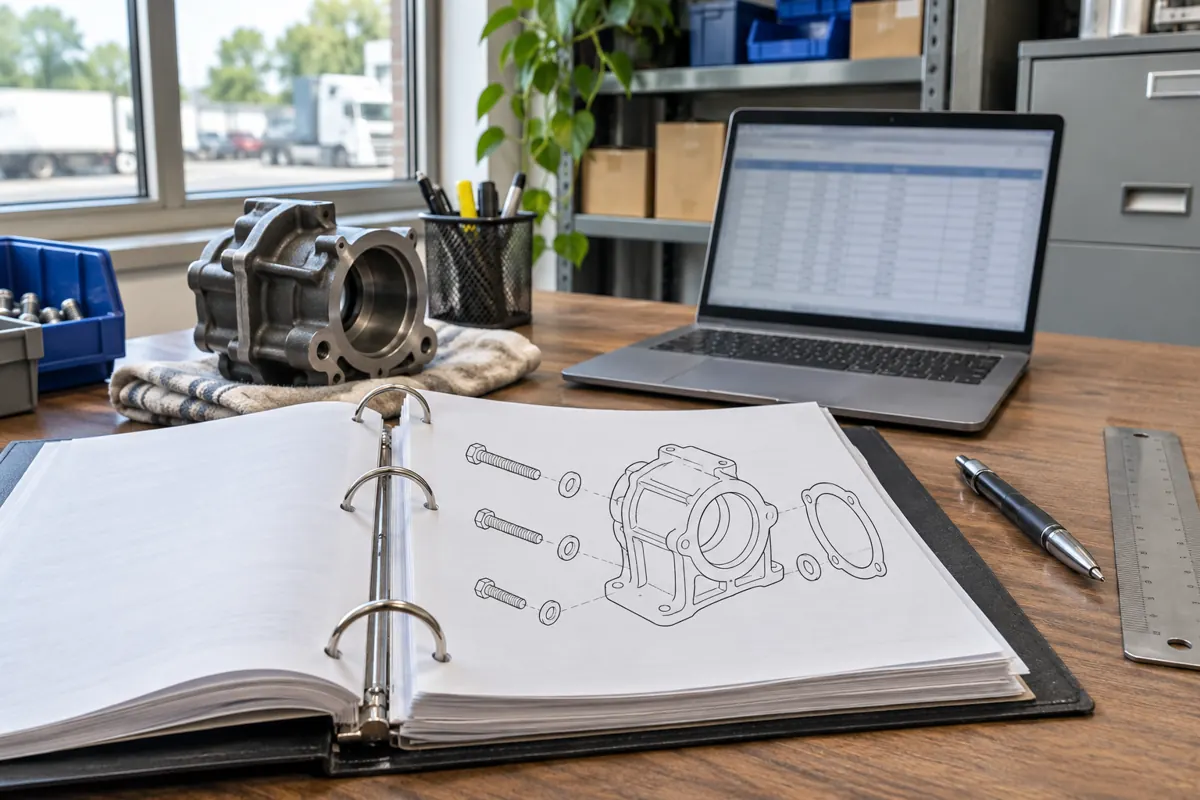
Locate the assembly heading before following an item-number leader line. Trace the line to the component it identifies, then find the matching item number in the table that belongs to that illustration. On a multi-page section, check whether the table continues on the next page.
| Field on the source page | What to record | How you use it |
|---|---|---|
| Assembly heading or group | The named assembly and any configuration notes | Check that you are in the relevant system and version. |
| Illustration number and page | The drawing identifier, printed page and PDF page if different | Let the supplier find the same illustration. |
| Item number or callout | The number identifying a component within that drawing | Locate the corresponding table row. |
| Part number or reference | The complete reference exactly as printed | Identify the component for quotation and matching. |
| Description | The table’s part name and any translated working description | Clarify which component or assembly you mean. |
| Quantity | The value and the scope defined by the catalog | Understand how many are shown for the stated application. |
| Remarks or applicability | Variant, position, dimensions, date range or other notes where present | Resolve which row applies to the fitted assembly. |
An item number is local to its illustration. The same number may identify a different component on another drawing. Copy the full part reference into the purchasing list and keep the illustration and item number in separate source fields.
3. Copy the Complete Reference and Read the Remarks
Preserve letters, suffixes and all digits as printed. If a scan is unclear, attach a close-up and mark the uncertain character for checking. Ask the supplier to confirm the offered reference in writing before approving the line.
Several rows can appear under one item number when a catalog covers alternatives. Read the applicability notes for each row and connect them to your actual assembly information. Ask for confirmation where the available information leaves more than one possible selection.
For an updated or replacement reference, record both the requested number and the proposed number. Ask the supplier to confirm the replacement relationship, the relevant application and any additional components needed for the change.
4. Establish What the Catalog Quantity Means
Read the catalog’s introduction, column headings and assembly notes to establish whether a quantity refers to one assembly, one side, one vehicle or another stated scope. A quantity beside a drawing needs that context before it becomes useful for procurement.
Next, have the workshop specify the repair quantity. A diagram can show every component in an assembly, while the approved repair may need only selected items. Keep planned dealer stock or fleet replenishment quantities separate from the immediate repair requirement.
| Quantity field | Question to resolve | Example of the distinction |
|---|---|---|
| Catalog quantity | What scope does the source define? | A quantity for one assembly needs the number of relevant assemblies to be understood. |
| Repair requirement | How many are required for the approved work? | The workshop selects the needed components after inspection. |
| Stock requirement | How much additional replenishment is justified? | The buyer adds separately planned stock based on demand records. |
| Order quantity | How many will you ask the supplier to quote? | Combine approved repair and stock demand, then check quantities already available. |
| Order unit | Does the price refer to a piece, pair, set or assembly? | A quoted set must have its contents and component count defined. |
For a hypothetical planning example, assume six approved repair jobs each require two pieces of one confirmed component. That creates a 12-piece repair requirement. Adding three pieces of planned stock gives 15 pieces before deducting usable inventory already available. These figures illustrate the calculation method and do not describe a HOWO component’s installed quantity.
5. Check Assembly Contents Before Adding Related Parts
A diagram may show an assembly and some of its individual components. Check which items are included in the quoted assembly so that you can identify what still needs separate ordering. Ask for an itemized contents list whenever the repair depends on bearings, fasteners, seals or other related items.
For example, the site lists SINOTRUK engine connecting rod assembly 161500030009. Use that verified product reference to start a sourcing inquiry. Confirm the engine application, relevant interfaces and whether the offered supply includes bearings or fasteners. The product reference alone does not establish fitment across trucks described as HOWO 371.

Keep the original diagram extract, old-part photo and relevant assembly identification together. For this example, the catalog page, illustration number, callout and fitted application remain items to confirm against your own source.
6. Build One Itemized Spare Parts List
Use one line for each distinct requirement. Record a stable inquiry line number so the workshop, supplier and receiving team can refer to the same item even when the list is sorted. A practical list can use the following columns.
| List column | What to enter |
|---|---|
| Inquiry line | Your unique line number. |
| Vehicle or job reference | Your internal fleet, vehicle or repair-job identifier. |
| Fitted assembly | Model and available identification for the relevant engine, gearbox, axle or cab. |
| Catalog source | Title or revision, page, illustration and item number. |
| Requested reference | The exact source reference, with unclear characters flagged. |
| Part description | The source description plus any useful clarification. |
| Order quantity and unit | Your purchasing quantity, stated in pieces, pairs, sets or assemblies. |
| Required supply scope | The component, kit or assembly contents you need. |
| Attachments and status | Photo filenames, outstanding questions and matching confirmation. |
| Supplier response | Offered reference, brand or supply option, contents and availability. |
The following example is a sourcing worksheet entry using a product reference verified on this site. Complete the catalog fields from your actual document. The requested quantity is illustrative.
| Inquiry line | Reference and description | Requested quantity | Source and matching status |
|---|---|---|---|
| 01 | 161500030009 — engine connecting rod assembly | 2 pieces | Attach the applicable catalog page and callout, engine identification and old-part photo. Application and assembly contents pending confirmation. |

Group additional requirements under the relevant engine parts, gearbox parts or axle parts categories while retaining the individual inquiry lines. A common component used for several jobs can be consolidated after its reference, version and required supply scope have been confirmed as the same.
7. Review the List Before Requesting a Wholesale Quote
Check that every line has a usable identification reference or a clear request for matching support. Resolve duplicate assembly-and-component entries, undefined units and missing source pages before using the list as a purchase approval.
Send the whole illustration and its accompanying table when possible. A tightly cropped part image can leave out the assembly heading, applicability note or row that the supplier needs to interpret the request.
Mark uncertain lines as pending. Ask the supplier to show any proposed alternatives separately and retain the written confirmation with the approved list. When references, quantities or supply contents change, give the list a revision date and use that version for quotation.
The HOWO wholesale ordering guide covers mixed orders and packing. Use the spare parts price guide to compare equivalent products, quantity units and delivery scope. HOWO PARTS supplies wholesale orders from China, with matching, availability and export packing agreed for the actual list.
Send a Diagram-Based Inquiry
Attach the itemized list, relevant catalog extracts, vehicle and assembly information, old-part photos, destination country and required timing. You can use the message below.
Please review the attached HOWO spare parts list and catalog extracts. Each line includes the available part reference, description, required quantity and unit. Please confirm the application and offered reference, clarify assembly contents, and identify any outstanding matching information. Show proposed alternatives separately, together with the brand or supply option, availability, packing and delivery scope. Our destination is [country], and the required timing is [date or urgency].
Send your diagram and spare parts list for review. If you need the relevant catalog first, start with the catalog and matching request page.
Frequently Asked Questions
Is the number next to a diagram component its part number?
It may be the illustration’s item number or callout. Match it to the accompanying parts-table row and copy the full part reference from that row. Read the source labels to establish how that catalog is organized.
Does a HOWO 371 parts catalog cover every truck called HOWO 371?
Check the document’s vehicle coverage, edition and assembly applicability. Confirm the fitted engine, gearbox, axle or cab, especially where a major unit has been replaced.
What should I send if I have only a screenshot?
Send the complete diagram, its parts table and the heading or source information available. Add the VIN, fitted assembly identification, old-part photos and required quantity so that missing details can be identified.
Why can one item number have several part-number rows?
A catalog may list alternatives under a shared illustration item. Read each row’s applicability and remarks, then confirm the relevant version for your assembly before ordering.
Should I order the quantity shown in the catalog?
First establish the scope of that quantity. Then calculate your approved repair and stock requirement, account for usable inventory and confirm the purchasing unit with the supplier.
Are the bearings and fasteners shown near an assembly included with it?
Confirm the actual supply contents. Ask which illustrated components are included in the quoted assembly and which need separate order lines.
Can I use a parts diagram as an installation or tightening guide?
Use the applicable repair or workshop information for assembly procedures, torque values and service measurements. Keep the parts diagram as an identification reference unless the source explicitly supplies the relevant service instructions.
Can several systems be combined into one wholesale list?
Yes. Keep each confirmed reference, quantity, unit and supply scope on an identifiable line, then request a mixed wholesale quotation. Packing and readiness should be checked across the proposed order.